

"You can't connect the dots looking forward; you can only connect them looking backwards. So you have to trust that the dots will somehow connect in your future."
Steve Jobs, Stanford commencement address, 12 June 2005
On Monday, Apple gets a new CEO. The company is fifty, and it is entering AI the same way it entered every other new market: via consumer devices.
Between 1985 and 1996, Steve Jobs's NeXT sold on the order of 50,000 machines, closed its factory, and became a software company with $273 million in accumulated losses.
Apple bought NeXT in 1996 for $429 million, making it one of the most consequential acquisitions in tech.
What Apple really wanted was the operating system and the engineers, Steve Jobs, not so much. Within a year, the acquired company was running the acquirer.
A few ago, I fell into an Apple history rabbit hole watching the Computer History Museum archive. I found the interviews and stories fascinating and packed with lessons about management, engineering, design, and product.
I've organized the main timeline here as a rough, high-level history of Apple's Second Act — the phase that paved the way for what the company is today.
Apple wanted an operating system, not a CEO
What Apple wanted from NeXT was the operating system it had failed to build for itself – but the CEO who came with it took over the company.
Mike Markkula was Apple's employee number three and sat on the board through the acquisition. Asked what Apple was after, he did not hesitate: "what we wanted was the OS. And Avie Tevanian."
Whether Jobs returned was less important to the board. Markkula:
"I don't think it was an issue. If he wanted to come back, fine, if he didn't, fine."
Tevanian became Apple's head of software. Jon Rubinstein, who had run NeXT's hardware, became head of hardware. Bertrand Serlet, who had built NeXT's AppKit, later ran all of Mac OS X. Scott Forstall, a NeXT engineer, ran the iPhone software team. Every major Apple operating system since 2001 descends from NeXTSTEP.
Joanna Hoffman was on the original Macintosh team and followed Jobs to NeXT. In her 2018 oral history, she described just how complete the replacement was:
"It was NeXT's software that created that Macintosh to the exclusion of the previous Macintosh. People don't remember the previous Macintosh."
Her shorter version: "today's Macintosh success is NeXT. You know? No question."
Timeline of Apple's second act, 1985 to 2008
Sept 1985: Jobs, demoted from the Macintosh division, resigns and takes five people with him.
1986: NeXT licenses the Mach kernel from Carnegie Mellon instead of writing its own.
1988: NeXT Computer launches at $6,500 with a magnesium case and no colour display.
1988: NeXT adopts Objective-C from Stepstone; Naroff moves it into GCC.
1989: Canon invests $100 million.
1993: NeXT closes its factory and becomes a software company.
1996: NeXT drafts an IPO it never files; Apple kills Copland and goes shopping.
Dec 1996: Apple picks NeXTSTEP over BeOS and buys NeXT.
Feb 1997: Tevanian and Rubinstein take over software and hardware; the deal closes.
1997: 300 R&D projects cut to about 50; Advanced Technology Group shut.
Aug 1997: Microsoft invests $150 million; Jobs becomes interim CEO.
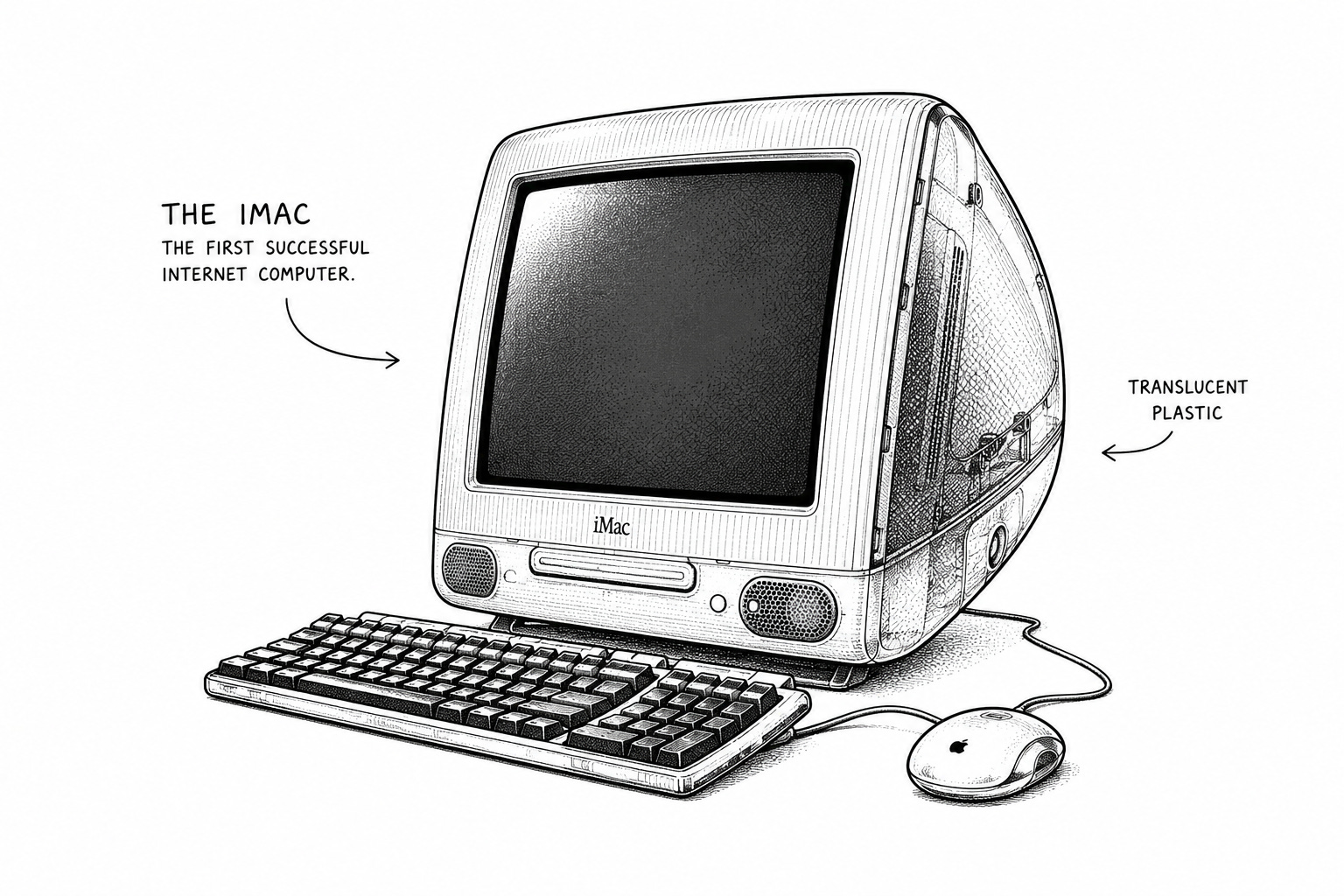
1998: The iMac, begun as a network computer, ships in fourteen months; Apple starts selling its ARM stake.
1999: The iBook ships with AirPort; Wi-Fi in a consumer product three years before Dell.
2000: Mac OS X's Aqua interface unveiled; Jobs drops "interim".
2001: Rubinstein finds the Toshiba 1.8-inch drive; the iPod ships in eleven months.
2001: Safari team picks KHTML over Mozilla.
2005: Two iPhone projects compete inside Apple.
Jan 2007: The iPhone is announced; Apple Computer, Inc. becomes Apple Inc.
July 2008: The App Store opens with 500 apps.
1985: Why Jobs left, in the words of the two men who were there
The familiar version has John Sculley firing Steve Jobs. Neither Sculley nor the board member who investigated the dispute remembers it that way.
Markkula had recruited Sculley as CEO in 1983. The Macintosh Office, launched at the January 1985 annual meeting, "was a complete dud." By March, the disagreement had become a fight over the company's priorities. Sculley:
"As we moved out into March, the Macintosh sales were not doing well and Steve and I started to have major disagreements on what we should do about it. Steve wanted to lower the price of the Macintosh. And yet he still wanted to run substantial advertising behind the product. And he wanted to de-emphasize the Apple II."
Jobs did not think Sculley would take it to the board. Sculley did:
"I said if you try to change that on your own, then I have no choice but to go to the board, and we need to bring this issue up with the board. And he didn't think I would do that. And I did."
The board sent Markkula to interview the executives and decide who was right. Sculley:
"Mike Markkula did that, took him about 10 days to conduct this project. He came back, reported to the board, and his conclusion was that I was right."
The board removed Jobs as leader of the Macintosh division. Sculley came from corporate America, where executives get moved around. Only later did he understand what the move meant to the founder who had created that division:
"The board asked him to step down from the role of leader of the Macintosh division. To be quite honest, I didn't appreciate coming out of corporate America, because remember people get moved around all the time in corporate America, I didn't appreciate what it meant to a founder, the creator of the Macintosh, to be asked to step down from the very division that he created."
The distinction matters. Sculley:
"So Steve was never actually 'fired' from Apple, but he was demoted from the role of leading the Macintosh division and then he went off on sabbatical and then he eventually resigned from the company and took a number of key executives and started NeXT Computing."
Markkula gave the same account separately:
"John came to the conclusion that Steve wasn't working for him. Steve was doing what Steve wanted to do and it was disruptive. And I think he made the only decision he could make, which is, he can't manage the company if Steve's going to run around and undo things and change it and cause him all this grief. So he reorganized and gave Steve a job that didn't have anybody reporting to him, and he had an office away from the main campus. He didn't fire Steve, but he made it so Steve had nothing to do so Steve decided to go off on his own."
Markkula's criticism was about how Jobs left:
"I don't criticize Steve for wanting to do that or doing it even, but I just wish he'd done that himself, got something started and then thought about hiring people, whether they were from Apple or anywhere else and done it on the up and up. What he did was, he got half a dozen people to agree to go with him, and I felt that was unethical and not the right way to do it."
Rich Page was one of those people. He supplies the date. Jobs resigned from the board on 12 September 1985. Page:
"then the five of us turned our resignations in on the Friday the 13th, and then you get sued. Steve gets sued the next day, and it takes about six months to get rid of that."
The five were Page, George Crow, Susan Barnes, Bud Tribble and Dan'l Lewin. All had worked on the Macintosh.
1985 to 1996: What happened to Apple while he was gone
Sculley ran Apple until June 1993. His defence is numerical: the company was profitable and growing when he left.
"When I left Apple, we had about 2-billion dollars of cash, we had maybe 200 million dollars of debt."
He puts the damaging choices after his departure:
"After I was pushed out of Apple, Apple decided to license the technology and stop making one or two cool products a year, and made many, many different products and the company started to spiral into huge losses."
Regis McKenna, who marketed the Apple II and knew Jobs for 35 years, watched from outside. His assessment of Michael Spindler, the CEO after Sculley:
"He could stand at a board and draw out a future strategy, and it would overwhelm you. He fell short in how you implement it."
Gil Amelio took over in February 1996 and found the result. The R&D count still sounds like a typo. It was not.
"There were 300 R&D projects, 300. I could make a case that maybe we needed 20 of those, and that might even been too big a number, but 300 was ridiculous."
He got the count to about 50. The factories were no comfort:
"We were getting back, some months, as much as 10 percent of the computers we shipped."
Copland, the in-house replacement for the Mac OS, had been in development for years at "a couple of $100 million a year" with no end in sight. Amelio killed it. Apple now needed an operating system it did not have.
1986: Why NeXT licensed Mach instead of writing its own kernel
While Apple was losing its way, NeXT was making the decisions that would eventually replace its software.
Avie Tevanian was a graduate student at Carnegie Mellon working under Rick Rashid on a research kernel called Mach. NeXT's engineers saw it presented at a Berkeley Unix conference and decided they wanted it.
Tevanian and Rashid flew to San Francisco for the conference and learned that Jobs wanted to meet them. Tevanian:
"We go over to the NeXT offices on Deer Creek Road and we're sitting down in the lobby waiting for Steve, and Steve comes down all excited. 'Hi guys, how you doing?' Shakes his hand. 'Oh, I've met you before,' that's what he says to me. Like, no, you haven't met me before."
Tevanian also interviewed at Microsoft and Sun. The choice came down to Microsoft and NeXT:
"Microsoft was very organized. They wanted to hire me. And NeXT wanted to hire me. So I had to decide between those two."
Had he gone to Redmond, he thinks a different operating system history would have followed:
"If I had gone to Microsoft, NT probably would not have existed, or would have been something different. Because they basically hired Cutler instead when I didn't go there."
That is the decision that connects an academic microkernel to every iPhone. Mach became the kernel of NeXTSTEP. NeXTSTEP became Mac OS X. Mac OS X became iOS.
1988: The factory, and the cube
https://www.youtube.com/watch?v=dSj6kvv7_Sg
NeXT built an automated factory in Fremont before it had customers. Jobs commissioned the film above because a slide could not capture the automation. A board goes from bare to populated in about twenty minutes, with robots placing components and no hands on the line. It is mesmerizing. It is also a factory waiting for buyers.
Rich Page took over manufacturing in 1991. The cube's magnesium case was beautiful and unforgiving:
"The NeXT cube was a magnesium structure but painted, as it turns out. I think that was a mistake, because it's hard to take something that's cast, whether it's cast a little bit over, cast magnesium, it's hard to take somebody has cast, sand it, do it right, texture, paint it, get it the right color, and have that whole process be repeatable."
The second-generation NeXTstation used a flat case the team called the pizza box.
https://www.youtube.com/watch?v=92NNyd3m79I
The launch took place at Davies Symphony Hall on 12 October 1988. The footage was thought lost until the production team of the 2015 Steve Jobs film recovered it from two VHS tapes.
On stage, Jobs listed what universities had requested:
"give us 8 megabytes of RAM, give us at least 100 megabytes of local storage."
The industry called that specification the "3M machine": a megabyte of memory, a megapixel display, and a million instructions a second. The NeXT machine cost $6,500 and shipped with a monochrome display. The factory film plays at 29:58; the cube powers on at 42:15.
Universities buy in academic years, through committees, at fixed budgets. That is not a market that absorbs a factory's worth of volume. NeXT sold tens of thousands of machines against a plant built for hundreds of thousands.
1988: Why NeXT chose Objective-C
NeXT did not invent its programming language. It licensed Objective-C from Stepstone, where Brad Cox had grafted Smalltalk-style objects onto C.
Steve Naroff was Stepstone's engineer on the compiler. He fixed the language for NeXT's needs and joined NeXT in 1988 after Stepstone failed to resource the work. There he moved Objective-C into the GNU C compiler and added categories, which let developers extend classes they did not own. Blaine Garst and Bertrand Serlet added protocols. Garst added reference counting to memory management.
The peer-reviewed history is a paper Naroff wrote with Cox and CHM curator Hansen Hsu, "The origins of Objective-C at PPI/Stepstone and its evolution at NeXT", open access.
C++ won the industry. Objective-C had one serious customer. Then that customer had Apple.
1989: Canon's $100 million
Ross Perot invested in 1987. In 1989, Canon put in $100 million for a minority stake, the figure repeated in every account of NeXT.
Susan Barnes, NeXT's CFO, raised the Canon money. She has never given an interview about it. Of the five people who left Apple with Jobs, she is the one whose account does not exist, and hers is the financial one.
1993: The decision to exit hardware
On 25 May 1993, Jobs opened a NeXT keynote with a summary of the retreat from hardware:
"We set ourselves a 100 day transition to move from a hardware systems company to a software company. We've succeeded. Been transitioning to a software company in this 100 days. Our factory's been closed, the inventory's been sold, we've seen the last of black hardware. We've sold our service business to Bell Atlantic. Our hardware designs are being sold to Canon."
The product was now NeXTSTEP for Intel. Page had left in 1992, and by then every co-founder except Jobs had gone.
What NeXT bought that day was portability: an operating system that ran on someone else's chips. Twelve years later, Apple used it to move the Mac to Intel.
1996: WebObjects, and the IPO NeXT never filed
Most Apple histories describe NeXT in 1996 as a failed company that Apple rescued. The company's own paperwork says something different.
In November 1996 NeXT drafted an S-1, the filing a company makes before going public. It was never filed, so there is no record at the SEC. The draft survives because Tevanian donated it to the Computer History Museum, and Hsu wrote it up.
The first number is grim: $273 million in accumulated losses.
The next numbers complicate the obituary. WebObjects, NeXT's web application server, plus OPENSTEP had made $10.1 million in the first nine months of 1996, or 45 percent of software revenue. NeXT was preparing to go public as a web tools company.
Apple did not intercept a corpse. It intercepted an IPO.
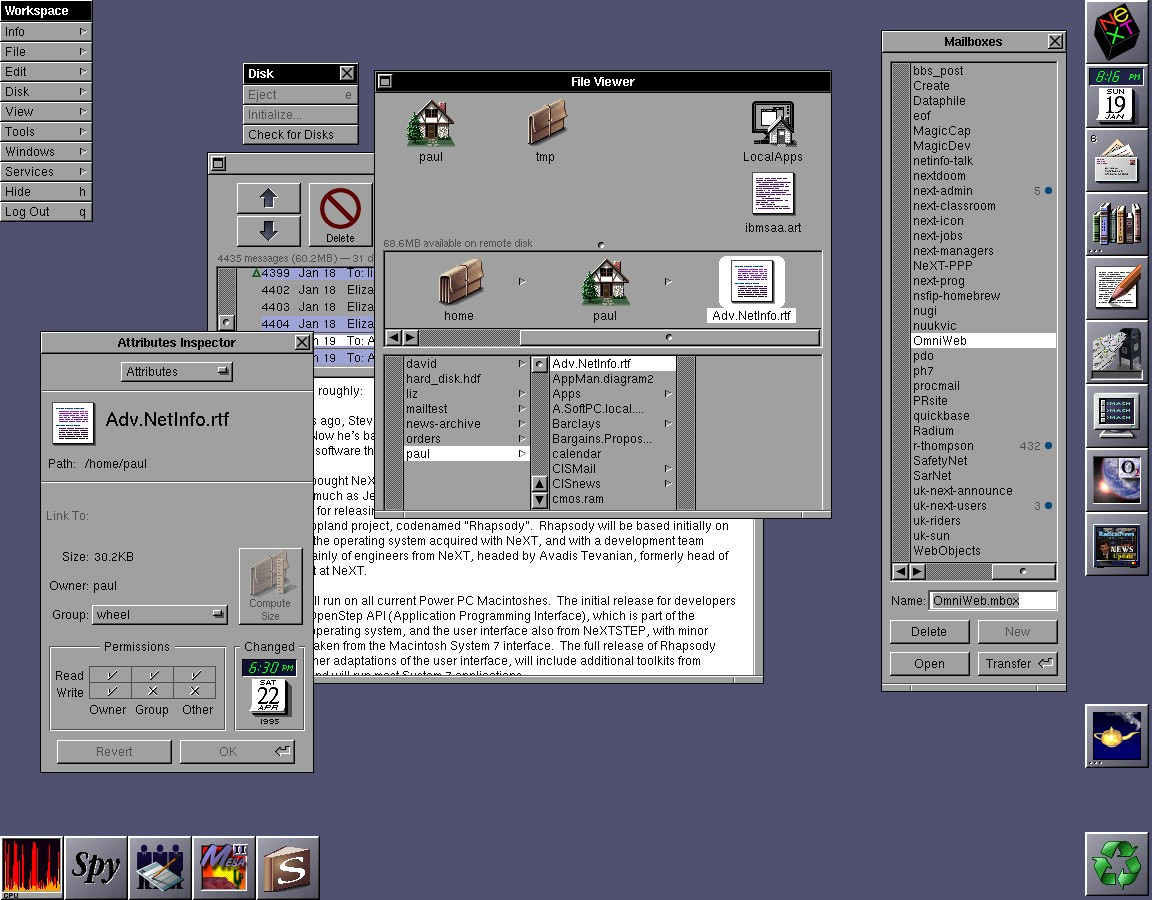
December 1996: What Apple bought, and what it chose it over
Amelio went to Sun first. Scott McNealy wanted to buy Apple; the plan was to put the Mac interface on top of Solaris. Sun's board stopped it. Amelio:
"At the end of the day, Scott McNealy's board turned us down. At that time, John Doerr was on their board, and I think he was, perhaps, most vocal in saying, 'No, we shouldn't make this connection.'"
Then came Be. Jean-Louis Gassée, who had run Apple's products in the 1980s, had built a new operating system. Amelio:
"Jean-Louis Gassée approached us about the Be operating system, and I'm kind of glad he did because it gave us another contender in the stack."
The Apple Fellows had already reached the same conclusion. Larry Tesler, who came to Apple from Xerox PARC and founded its Advanced Technology Group, says the group debated porting the Mac OS to Intel around 1995, rejected it, and recommended buying an outside OS instead.
NeXT had the best operating system and the most troublesome association. Amelio:
"the NeXT operating system was the best choice out there. I would say virtually everybody felt like we shouldn't touch it because of Steve Jobs. Every one of my board members and most of my staff told me forget about it."
He kept talking to Jobs because the remaining options were not close:
"because if I couldn't get Sun, then the third, whatever was third on the list was so far down the list that it really wasn't a viable strategy."
Markkula confirms that Amelio made the call:
"Gil is the guy that came to the conclusion that we needed to buy an OS. The other one we looked at was Be. And Jean-Louis had done a really good job with that, but it wasn't finished."
The decision would end Amelio's own tenure. He knew the risk:
"I agonized more over the decision as to whether to bring Steve Jobs back more so than I think any other decision I made in my life."
Ten years after Jobs left, Amelio's reasoning was that "it was still his company."
From NeXT's side, the deal happened fast. Calls went in to Amelio, technical diligence meetings followed, "and in basically under a month we had a signed deal to be acquired."
Then Apple pre-announced a major loss. Tevanian:
"Right after signing the deal to be acquired, so now we're looking at late December, couple days before Christmas, '96, as that quarter is coming to a close for Apple, they had to pre-announce a major loss, and that kind of took us by surprise. We certainly didn't see that coming, just because we weren't watching the company at all. We knew the company was struggling, but we didn't know that it was that bad off."
The price was $429 million, announced 20 December 1996. What Apple got for it: the Mach kernel, the NeXTSTEP operating system and its OPENSTEP frameworks, the Objective-C toolchain, WebObjects, and the engineers who had built all of it. Apple's FY2000 10-K books the deal with a $375 million charge for in-process research and development.
Both part 1 and 2 of Avie Tevanian’s oral history are very interesting, but the second part is when he covers the NeXT acquisition forward:
February 1997: The NeXT people take over
At the WWDC 1997 opening keynote in May, Amelio is still CEO, Tevanian and Rubinstein already run software and hardware, and a young Scott Forstall does a demo. The recording is on the Internet Archive and has about a thousand views.
Jon Rubinstein had run NeXT's hardware. He started at Apple on 3 February 1997, the day the deal closed. Apple had lost $740 million in the preceding quarter. Rubinstein's estimate: "Yeah, we had one quarter left when I got there."
He puts the company's value at about $2 billion. "It's a trillion today, it was 2 billion."
Rubinstein's arrival was not advertised around the office:
"They kept me, in particular, hidden for three days because I was going to replace like five division managers, right, because we were going to collapse all these divisions."
Larry Ellison later said Jobs had planned the takeover all along. Rubinstein's response to the version told at Jobs' memorial:
"that bullshit that Larry spun, Ellison spun at his eulogy, at his funeral and stuff was nonsense."
Rubinstein leaves room for the possibility that Jobs kept a secret from him, but not much:
"Larry has been quoted as saying, 'No, no, no. Steve had this strategy of how he was going to do this, and he was going to get back to take over the company.' That is certainly not what I saw. Now, it may be that Steve kept it secret from me. Anything is possible, but we were pretty close at the time. And I know Laurene didn't want him to go back, right, because it meant he would disappear."
1997: Cutting products, and killing the research group
On 13 May 1997 Jobs sat on a stool at WWDC and took developer questions for an hour and eleven minutes. He held no title at Apple. The first question was about OpenDoc, a component technology Apple had been pushing for years, and he said he was for putting a bullet in its head. YouTube copies of this one get removed periodically; the Internet Archive copy is the durable one.
The cuts went beyond products. Larry Tesler had founded Apple's Advanced Technology Group. In 1997, he was asked to close it.
Tesler:
"In 1997, beginning of '97, when Steve Jobs was half back, Gil Amelio was still running the place but kind of doing what Steve had recommended he do, Avie Tevanian, who was running software at that time, came to me and said, 'We're shutting down ATG. People say, oh no, we're going to lose a lot of great ideas. Since you started it, would you go over there and find out what the great ideas are that are still there and which ones we should save and which ones we should kill?' So I was sent back there to kill the organization I had founded, but I'm glad he did it. It was the right thing to do."
The group had ideas. Relevance was the problem:
"They were all really cool, but they were irrelevant. There was one that was Microsoft Surface, so it was 1997 to 2012, so 15 years. It was 15 years ahead of its time."
July 1997: Amelio out
Fred Anderson was Apple's CFO. Tevanian recounts the moment Anderson called Ellen Hancock after firing Amelio:
"right after calling Gil he called Ellen Hancock, who was also being fired, to tell her she was being fired and she first said, he first said to Ellen, I think, something to this order, 'Gil is no longer CEO,' and she thought he was calling her to make her CEO."
McKenna kept a notebook. An entry from early January 1997, after Jobs met Amelio, records that Jobs:
"said they don't appear to want help. They didn't offer him a job. They didn't ask him to be a consultant. They didn't offer any position to him at all."
McKenna's explanation for why 1997 worked when 1985 had not:
"I think he was just so far better equipped to do that in 1997 or '98 than he was in 1985. He had gone through NeXT and putting that system together with the importance of software, and then Pixar, the professionalism of the staff and the management and how they did things."
Then, a few months later, the phone call. "His first words were, 'What do you think about my new board?'"
August 1997: The Microsoft $150 million
At Macworld Boston on 6 August 1997, Jobs announced the new board and then the Microsoft deal: cross-licensing, a commitment from Microsoft to release Office for the Mac, and $150 million in non-voting stock.
Bill Gates appeared by satellite on the screen behind Jobs. The room booed.
Six weeks later Jobs spoke to Apple employees about the new ad campaign.
https://www.youtube.com/watch?v=NiwJ26kc2YE
Jobs explained what Apple needed people to remember:
"To me, marketing is about values. This is a very complicated world, it's a very noisy world, and we're not going to get a chance to get people to remember much about us. No company is. And so we have to be really clear on what we want them to know about us."
The campaign would not be about specifications:
"The way to do that is not to talk about speeds and feeds. It's not to talk about MIPS and megahertz."
The spot would break that Sunday on ABC, around the network premiere of Toy Story.
1998: The iMac started as a network computer
The product that put Apple back in front of new customers began as something else. In 1997 Larry Ellison, Jobs's closest friend and about to join Apple's board, was evangelising the network computer: a cheap machine with no hard drive that ran off a server. Apple started building one. Jon Rubinstein, running hardware, had shipped a computer with no hard drive once before, at NeXT.
"I keep going, 'The NeXT machine with no hard drive didn't work out well. This isn't going to work well because it doesn't have the,' we talked about balance before. 'The networks aren't fast enough yet to have the kind of balance you need.' But Steve kept pushing forward with it, and Fred kept going, 'Wait a minute, we need an entry roadmap.' So finally, we had sort of a knock-down-drag-out one day and we decide that we're going to switch the network computer to becoming the iMac and we grow the enclosure a little bit and we stick a hard drive in it."
Fred is Fred Anderson, the CFO, who Rubinstein says "deserves a lot of credit because he's the one who kept going, 'We need to have an entry-level product.'" The motherboard came from the existing G3 desktop. The schedule was the other decision.
"Normal product development at Apple took three years, and I'm like, 'We got to get to one-year cycles.' [...] And everyone goes, 'That's impossible.' Right? And I said, 'No, no, no. We're going to redo all of our processes at the same time.'"
He used the iMac to install the development process Apple still runs: gates, milestones, manufacturing engineers in from the start, legal agreements signed before shipment. The last of those came from a display supplier whose panels were failing in the field at forty to fifty percent when he discovered the contract had never been finished. "I used the iMac as kind of the pipe cleaner, right, to clean out the pipe and to institute all-new processes around how we're going to do stuff at Apple." It took fourteen to sixteen months.
Two more decisions came with it. Rubinstein chose USB, then shipping on a million PCs that nobody used it on, over Apple's own ADB and over FireWire, which was too expensive for a low-end machine. And the floppy drive went.
"There were not peripherals out yet, right, but they were going to come, eventually. I mean, a million PCs had shipped with USB. They just, no one used it."
The peripherals had to be conjured. Apple was shutting down a billion-dollar printer business at the same time, and Rubinstein called Epson and HP: "Dudes, I got a billion-dollar printer business. Anyone want it?" Both built USB printers to match the iMac; Epson's came in the same colours.
The launch nearly did not survive the CD drive. During rehearsals Jobs saw the tray slide out and called Rubinstein screaming.
"He goes, 'But what's this tray that comes out?' I'm like, 'That's how they work, right? I mean, that's what all computers have.' He goes, 'Well, I want it to be like my car where you just, you have slot-load.' And I'm like, 'Well, they don't make those.' Right? And he goes, 'Well, this destroys the product.'"
It shipped with the tray. The next generation had a slot. Rubinstein's verdict on what the product did: consumer market share "which had dropped below 2 percent, was heading back up to 8-percent kind of range." And on the one part he still regrets: "That round mouse was terrible. Yeah, that was a bad product, right, and that was industrial design sort of trumping human factors."
1998: How the failed Newton kept Apple alive
Apple had co-founded ARM in 1990 to build the processor for the Newton, Sculley's project. Sculley says Apple held "47 percent" and describes the sale as one of two things that kept the company alive:
"I give Gil Amelio credit for two things, one was he sold the 47 percent that Apple owned of ARM for about 800 million dollars, or so I'm told, and that 800-million dollars was crucial to keeping Apple alive, and he brought Steve Jobs back. If those two things hadn't of happened, there never would have been the rest of the story."
Apple's own filings put it differently. The FY1999 10-K says Apple owned 42.3 percent of ARM in September 1997, and that the selling began in October 1998, more than a year after Amelio left. That month Apple sold 2.9 million shares and its stake fell to 19.7 percent. During fiscal 1999 it sold about 32.6 million more for net proceeds of about $245 million, booking a gain of about $230 million. In the first quarter of fiscal 2000 it sold another 5.1 million shares for about $136 million.
By September 1999 Apple had $3.226 billion in cash and short-term investments, up $926 million in a year. Some of that was the iMac. A meaningful piece of it was ARM.
Sculley's timing and total do not match the filings, and I have not tried to reconcile them.
The accounts agree on the consequential part: Apple sold most of its stake in the company behind the chip architecture it now uses in every Mac, iPhone and iPad.
1999: AirPort, the Wi-Fi Apple did not invent
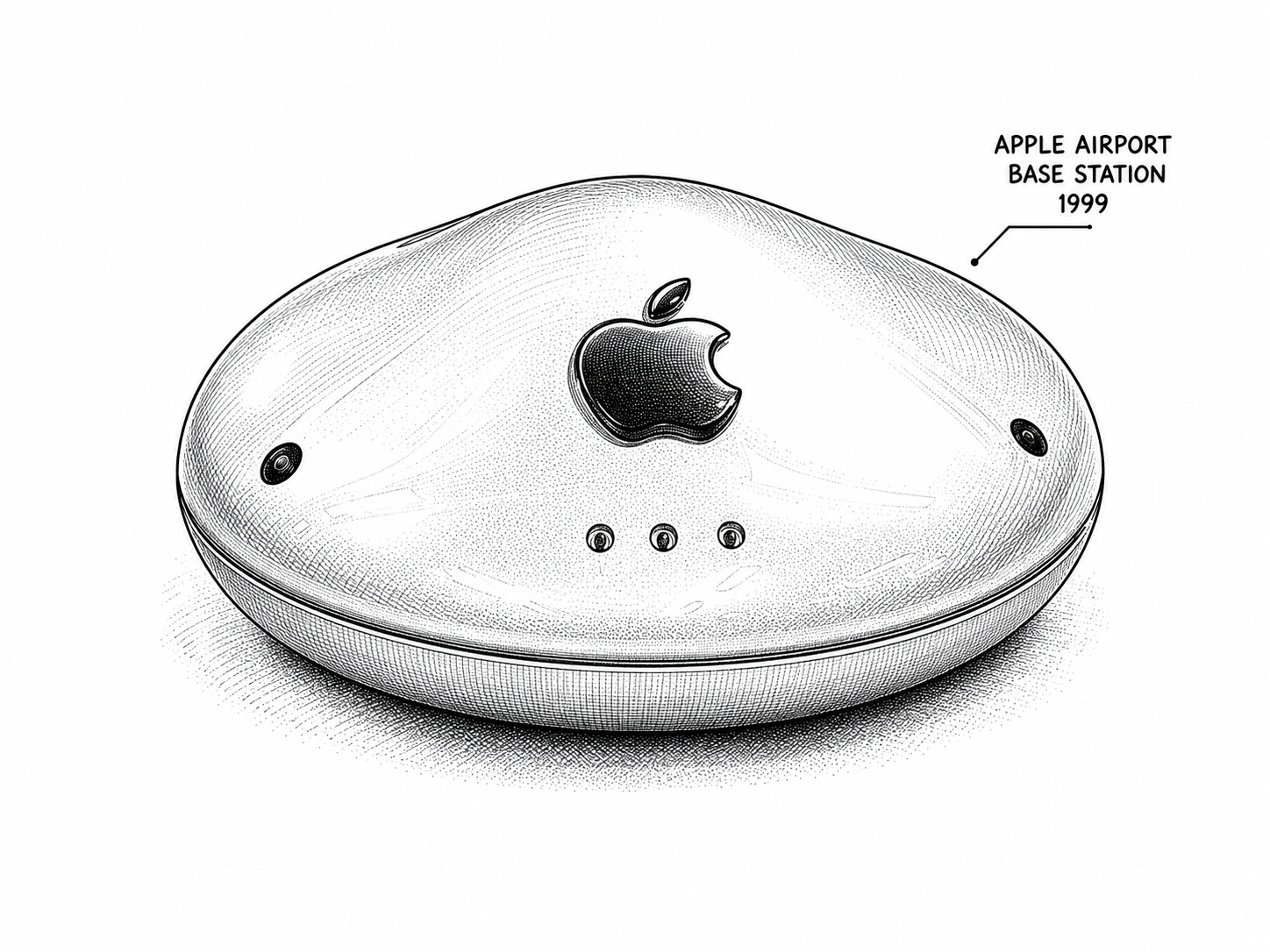
Rubinstein ranks it above the iPod: "the one I'm almost more proud of is Wi-Fi, Wi-Fi base stations, right? And we created that, right? We didn't invent it, but we created it."
The problem was schools. The iMac had taken Apple back into education, the iBook was being designed as its portable sibling, and classrooms needed networking that did not involve opening walls.
"Schools are impossible [to] rewire because of asbestos. A lot of the schools were old, had a lot of asbestos, so you can't go digging in the walls. So we spent a lot of time looking at powerline, at wireless, at phone line, all the different kinds of networking. [...] Intel was doing HomeRF, which was sort of the more popular standard at the time. I mean, no one shipped it yet, but it had a lot of momentum going behind it. And the other one was Wi-Fi, which was mostly used for industrial control at the time."
Apple picked Wi-Fi against Intel's standard. The technology came from a group outside Amsterdam that had passed from NCR to AT&T to Lucent, selling cards for a couple of thousand dollars and base stations for ten thousand to factories.
"Tim Cook did a great job negotiating a deal with them. I mean, he really, we spent a lot of time together over there working on this, and he really convinced them to drop their drawers and give us pricing that was unbelievable so that we could do basically $100 plug-in cards and couple-hundred-dollar base stations."
The iBook team was told to add antennas and connectors to a product already in development, at a cost they resisted. The RF engineers came from the Advanced Technology Group Apple had just shut down; one intern in the Wi-Fi group went on to found Ubiquiti. Then the launch, at the Javits Center in New York in July 1999.
"We took an iBook, we put an accelerometer on it, right? We put Phil Schiller on top of it, and we threw him off of it to land on the airbag and then wirelessly we broadcast the data from the accelerometer on the screen. [...] And then, every fourth or fifth seat in the audience, we put an iBook below it. Right? And so then Steve goes, 'Okay. Everyone reach below.' And we had Apple employees in the audience, right, and everyone pulled out their iBooks and started surfing the internet wirelessly in the audience."
The venue's lawyer tried to stop the jump that morning; Apple's general counsel wrote a liability release on the back of her business card. Rubinstein: "that's the beginning of Wi-Fi, right, of commercial and consumerized, commercial, consumer Wi-Fi. Yeah, three years ahead of Dell." Apple shipped "$20 million worth of antennas and connectors" into its products before the standard had any traction.
Then Intel tried to change the rules of the unlicensed radio band in HomeRF's favour, and Rubinstein went to Washington.
"I spent a bunch of time in D.C. at the FCC and at the House Telecommunications Commission talking to people about why they shouldn't change the standard and why Wi-Fi was the right way to go and why you shouldn't let Intel change things."
What Apple did not do is the part he still argues about. With Wi-Fi winning, he asked Jobs for three or four engineers to port the base station's configuration software to Windows and sell AirPort into the PC market. "Steve goes, 'Over my dead body.'" Jobs's reason was that AirPort was part of what made a Mac worth buying. Rubinstein thought it was a multibillion-dollar networking business; he lost, and says the loss is why he and Phil Schiller fought so hard, three years later, to take the iPod to Windows.
On the name: "We named it AirPort Base Station but that wasn't because we thought it was going to actually be in airports. Right? I mean, that was never in our thinking. Starbucks, McDonalds, I mean, we never thought about it that way. Right? And anyone who says we did is fibbing, right, because we didn't think that big. Right? This was, how do we sell more Macs?"
2000: Carbon, Aqua, and the compromise that made Mac OS X shippable
Adobe and Microsoft would not rewrite their applications for NeXT's frameworks. Apple built Carbon, a compatibility layer that let existing Mac software run on the new operating system with modest changes.
"Carbon and Cocoa were both peers, if you will. There was, at least in the early days, there was no plan to sunset Carbon any time soon, and yet we wanted to make sure that people transitioned so you didn't really see new features coming out on Carbon whereas you did on Cocoa."
The cost was a decade of two parallel APIs. The benefit was that Mac OS X shipped with software on it.
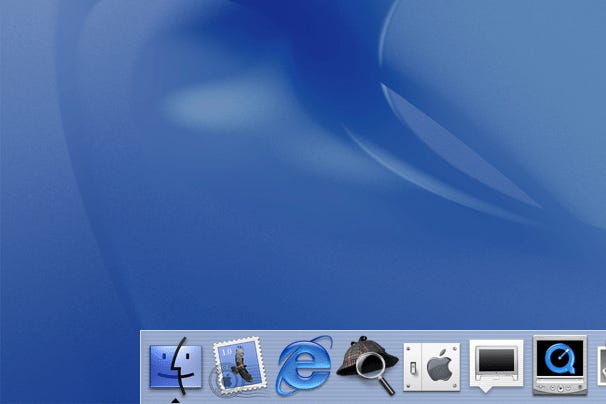
Bas Ording designed the Aqua interface and, later, the iPhone's. Jobs recruited him with a phone call at home in 1998, when Ording also had an offer from MetaCreations.
Rubber-band scrolling, the little bounce when a list reaches its end, came from a bug. Ording was building the phone's scrolling contacts list:
"I was constantly changing stuff in my code, like I thought I was running the code but then it wouldn't scroll. I'm like, oh, I guess I'm not running the code yet. Like, wait, but then it was running. Oh wait, I'm scrolling the wrong direction, because it's at the top of the list and it's not gonna go any further."
A list that refused to move looked broken. Ording:
"feels sort of weird, as if the program is just stuck or something. And so that's when I started to think about what can we do to make it feel still alive somehow."
Serlet led the engineering. He had joined NeXT in 1989 following Jean-Marie Hullot from the French research institute INRIA. He ran Mac OS X until 2011, when he recruited Craig Federighi to replace him and left.
2001: The Toshiba drive, and the iPod
Rubinstein describes the iPod as a procurement story.
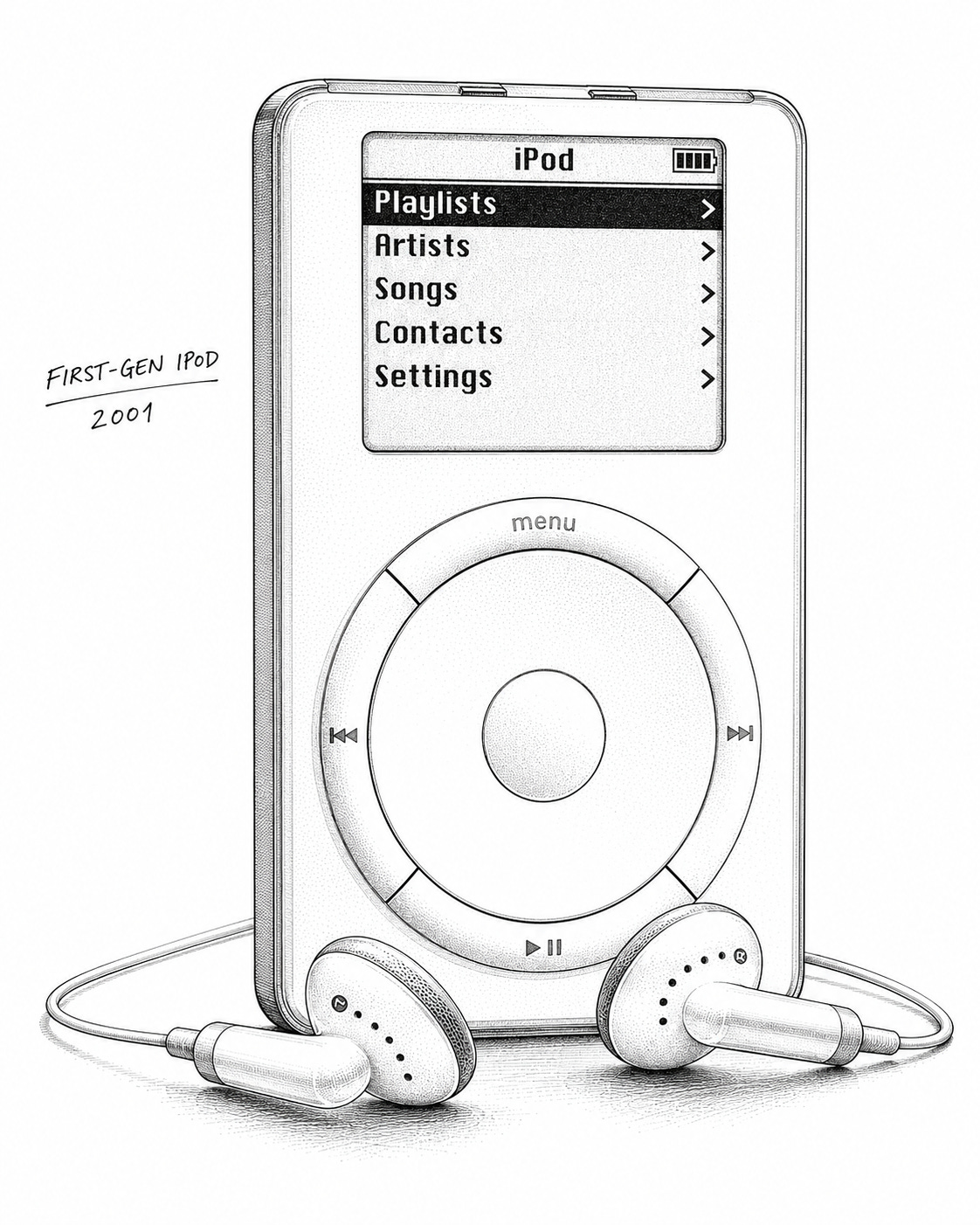
He needed a small hard drive. At IBM Research, he saw the Microdrive in development and asked for five gigabytes at his price. The answer: "They laughed at me. Right? 'Never going to happen.'"
Rubinstein kept looking. In Japan, he found a Toshiba drive whose makers did not know what to do with it:
"So I kept looking and eventually I was in Japan and found the Toshiba drive and they weren't really sure what to do with it because it didn't have enough capacity to really go in a PC."
The meeting had been about other products. The useful part arrived at the end:
"They were taking us through their roadmap for all of our other products, and at the end of the meeting, they go, 'We have this other thing. Would you like to take a look at it?' I'm like, 'Yeah, sure. I'll take a look at it.' So we looked at it, and like it's obvious, right? This is how to make an iPod, right?"
Jeff Williams, now Apple's chief operating officer, was in the room.
Then came the money:
"Steve was in Tokyo, so I said, 'Steve, I need a $10 million check to go do development on this.' And Steve goes, 'No problem, I'll write you the check.' So then I talk to Fred to make sure the check won't bounce because Steve, Fred was the guy who actually wrote the check, not Steve, and Fred goes, 'Go ahead. The check won't bounce.'"
Phil Schiller supplied the scroll wheel idea:
"Phil Schiller is the one who came up with the scroll wheel. He had a B&O phone, an old B&O phone that had the scroll wheel, right, and they didn't have acceleration in those days. But so we grabbed that idea. We patented it right away, and we actually ended up licensing that patent back to B&O. I don't think they really knew that we'd lifted it from them."
Tony Fadell, who ran the iPod division, tells the origin differently. Rubinstein:
"Tony has re-spun the whole story that he came up with the idea of the iPod and that Steve called him and, I mean, that's all nonsense."
Fadell gives his account in his own book and interviews. The two heads of Apple's hardware disagree on the record about who thought of the iPod.
2001: KHTML over Mozilla
Richard Williamson had joined NeXT out of Swarthmore. Ken Kocienda joined Apple in 2001. Together they built Safari.
In June 2001, Forstall asked Don Melton to start a browser team. Mozilla, the open-source descendant of Netscape, was the obvious base. Williamson chose KHTML, the rendering engine from the KDE desktop project, instead.
The size difference mattered on a team this small:
"Mozilla was the leading candidate at that point, the other leading candidate, but it was a million and a half lines of code, and KHTML 150,000 lines of code. And there you go, it's three guys."
Kocienda says the decision turned on:
"the utterly amazingly convincing demo that Richard made to get this code working on the Mac."
KHTML became WebKit. WebKit became the engine in every iPhone browser.
2003: Safari launches
Don Melton ran the Safari project from its first day, 25 June 2001, and has not sat for a CHM oral history, but he wrote the launch up on his own blog ten years later. Two posts carry this section: Safari is released to the world and Memories of Steve. Melton now publishes as Lisa Melton.
The secrecy problem in 2002 was hiring. Andy Hertzfeld had worked out what Melton was doing before his first day and kept quiet. One hire was too visible to hide:
“However, when I hired Dave Hyatt in July 2002, then guesses started flying fast.”
Hyatt had built Chimera at Netscape and co-created the project that became Firefox, both on Mozilla’s Gecko engine, so the industry assumed Apple was building a Gecko browser. Melton had chosen KHTML a year before Hyatt arrived.
Jobs opened the Safari segment of the 7 January 2003 keynote with “So, buckle up,” then stated the goal:
“Then he defined one of our product goals as, ‘Speed. Speed.’ So, I tensed up. Not that I didn’t agree, of course. I just knew what was coming soon: Demo time.”
Melton had sat through at least four rehearsals. At one of them Safari hung on stage because the whole network connection had failed; Kocienda found the cause, and IT set up a redundant link.
“And for the entire six minutes and 32 seconds that Steve used Safari on stage, I don’t remember taking a single breath. I was thinking about that network failure during rehearsal and screaming inside my head, ‘Stay online, stay online!’ We only had one chance to make a first impression.”
Then the slide naming the engine:
“Then Steve moved a new slide onto the screen. With only one word, ‘KHTML’—six-foot-high white letters on a blue background. If you listen to that video I posted, notice that no one applauds here. Why? I’m guessing confusion and complete lack of recognition.”
“What you also can’t hear on the video is someone about 15 to 20 rows behind where we were sitting—obviously expecting the word ‘Gecko’ up there—shout at what seemed like the top of his lungs: ‘WHAT THE FUCK!?’”
In Ken Kocienda’s book, Creative Selection, he describes Jobs setting page-load speed as the standard the browser would be judged by, Melton proposing a test program to measure it, and the Page Load Test Kocienda built to run against every change, with one rule: nothing that made the browser slower went in.
In the summer of 2002 Jobs wanted the status bar gone:
“Steve didn’t like the status bar and didn’t see the need for it. ‘Who looks at URLs when you hover your mouse over a link?’ He thought it was just too geeky.”
Melton and Forstall kept it as an option, off by default. The progress bar had lived inside it and needed a new home.
“The room got quiet. Steve and I sat side-by-side in front of the demo machine staring at Safari. Suddenly we turned to each other and said at the same time, ‘In the page address field!’”
“The irony of that invention is that years later I tried to get the whole feature removed. Because even when precision testing showed that Safari loaded pages faster than any other browser, that damn in-your-face progress bar made it seem slower to the user. Its wonderful visibility was killing our reputation.”
2005: The Intel transition
NeXT ported its operating system to Intel in 1993 because it had to survive. In 2005, Apple used that same operating system to move the Mac to Intel. Tevanian ran software through both transitions; he treats the second as the payoff of the first.
John Markoff, interviewing him, remembers Jobs hinting at the switch a year before it happened. Tevanian’s answer is that the product already existed:
“That’s because we already had it working. [...] So one of the things about being in tech, right, is when a product is announced it was already working well before that and so the people who were already working on it knew that it’s coming. Now, he may not have known the exact date but as far as I was concerned, we were working on that product the day I started at Apple in ‘97, and we had software running on all the Macs throughout all those years.”
He did not know which form the move would take, only that it would come:
“For me, having our software running on an Intel processor at some point in time was inevitable, and so it always was about options and how we would execute those options, and so I didn’t know if, like at NeXT we got out of the hardware business, Apple would have to get out of the hardware business, as a really radical change, right, in which case we’d have software to OEM to different people, or we’d be in the hardware business, maybe building premium computers, which Apple’s always been great at, with someone else just doing a super-low-cost computer, right, which would probably be based on an Intel processor.”
The job, as he saw it, was to keep the option cheap:
“I knew that at some point in time Steve was going to say, ‘I need this product.’ Okay. And I knew, starting from scratch, it was a three- to five-year effort, because of everything involved, okay. To port an entire OS and do emulation and everything else, and so I knew I had to have it ready so that when it was time to pull the trigger we could get it out in 9 to 12 months, which is what we ended up doing.”
Serlet, who ran Mac OS X engineering under him, describes the mechanism. Every project had to build for a processor no shipping Mac used:
“We had several kind of points in time where we thought the PowerPC was not moving fast enough from a technology standpoint, and we should move to Intel. One thing that Avie pushed, and I enforced it, is that we always compiled our code for Intel as well as PowerPC, even though we had no Intel machine and so we had some checkers in place in the build system to make sure every single project can be built for Intel and this is years before we did the transition.”
Rubinstein, on the hardware side, had lived the PowerPC problem. On the G5 tower:
“That was a real slog with IBM, who did the processors, G5 processor for-- it was an amazing product.”
Jobs and Paul Otellini signed the Intel deal in February 2005. The developer conference was in May. Serlet:
“We just scrambled to make it happen for the developers conference that was in May, so three months later [...] We wanted also developers to have machines that they can play. But we didn’t want the Mac OS to run on any PC. So there was a delicate balance. So we decided to build machines in secrecy and in fact, we enlisted Simon Patience’s team, which was the CoreOS team, to actually build the machine that we were going to give for developers at the conference. So for a while, the kernel team was actually building, assembling machines in a secret lab in preparation for WWDC.”
The circle of people who knew grew from a dozen in February to several thousand by June, and nobody leaked. The booth staff at WWDC were told an hour before the keynote.
On stage Apple said a year. Inside, Serlet refused to give a date at all:
“We said at that time that it would take about a year to transition and nobody believed it. All the industry thought that it would take much longer. We were hoping it would take less. But we were not sure, because we had a dependency on Intel for some of the new chips coming up. So we were not sure, and still we’re not sure, for several months. So I said, well, we’re going to pretend we need to ship ASAP and we don’t have a schedule, but we just have a punch list of what’s left to do and we’re going to shrink the punch list and that’s what we did. People were upset because they wanted to know the schedule and I said, sorry, I can’t tell you the schedule, I don’t know the schedule, but it’s ASAP, and so we were able to ship in January with the new Intel Macs and so that was six months, not a year and then the rest of the transition was done in less than a year, the rest of the transition of the machines.”
For the year in which both kinds of Mac were on sale, he forced one code base through software update:
“I wanted the transition to be viewed as invisible. So what we did for the rest of that year is we did software updates that had all the improvements that we made to the Intel side. But that also were all those improvements that were not for PowerPC, but we also included that in the PowerPC update and so we had a single code base. We forced the code base to be the same through software update. So by the time January came in with the new Intel machines, they were exactly the same software as the PowerPC. So no one ever found some bug difference between the two.”
Tevanian’s summary of what the customer was supposed to notice:
“One day a Mac had a PowerPC. The next day it had an Intel, right? But it was still a Mac.”
The Intel Mac lasted fifteen years. In June 2020 Apple announced it would move the Mac to its own processors, the same ARM-derived architecture as the iPhone, and by 2023 every Mac shipped on them. The people on tape did not predict that in so many words, but Rubinstein describes the two steps that led there. The first was the iPod’s processor. When PortalPlayer, the merchant-chip supplier for the first iPods, pushed back on Apple:
“We went to Samsung, and we worked out a deal with Samsung where they were going to do multiyear, multi-family processors for us basically to our specifications, and they went and did that, and we got rid of PortalPlayer. [...] They built processors, and I think they built all the processors for Apple until Apple started using their own basically.”
The second was the 2008 purchase of P.A. Semi:
“I don’t think they got the chips, but they got the core design, and they developed on top of it, but for many years we used a Samsung roadmap, a multiyear roadmap and stuff.”
The reasoning goes back to his NeXT years, where a computer took three or four years to build and was out of date when it shipped:
“One of the things I started getting in my head is, we want to do one-year cycles. Now, that leads to a problem in that it takes more than a year to do a chip, right? See, then you have to really have a pipeline of chips you’re working on, and so you have to have enough resources to where you can put in place a roadmap with a pipeline of chips for both processors and control chips and all of that.”
Asked whether that meant making your own chips: “You can buy stuff outside, but if you want to build a real system, you got to do your own chips.” Asked whether that included the microprocessor, in 1990: “No, no, you don’t have to build a microprocessor. You can buy that outside.” Thirty years later Apple built that too.
2005 to 2007: Two iPhones, one shipped
Scott Forstall gave one substantial public interview after leaving Apple in 2012, at CHM in 2017. He tells the origin of the iPhone's interface this way.
The origin begins with Jobs disliking a man at Microsoft. Forstall clarifies that it was not Bill Gates:
"It wasn't Bill, because he was starting to like Bill by this point. It was, Laurene had a friend, so Steve's wife had a friend who was married to a guy who worked at Microsoft. Every time Steve had any social interaction with that guy, he'd come back just pissed off."
One of those social encounters supplied the provocation:
"He came back one time after seeing this guy, and that guy was talking about how Microsoft had solved computing, they were going to do tablet computing, and they were going to do it with pens. And he just shoved it in Steve's face, the way they were going to rule the world with their new tablets with their pens. And Steve came in on Monday and there was a set of expletives, and then it was like, let's show them how it's really done."
Jobs's requirement was no stylus:
"The first thing is, they're idiots, you don't use a stylus. It's cumbersome, you lose it, you're always picking it up and putting it down. We're born with ten styluses. So let's use the ones that we don't have to sell."
That was a tablet project. It became a phone because of what was happening to the iPod. Forstall:
"I think half of our sales at the time were iPods. So we were turning into this consumer electronics company. We were always looking at what was going to take over the iPod space, like was something going to cannibalize music sales and iPod sales, and the one thing that seemed like it might do it would be phones."
Two teams competed. Nitin Ganatra, who ran iOS applications, describes P1, an iPod-derived phone under Fadell, and P2, the OS X-derived phone under Forstall, which Apple internally called Purple. P2 won. Its foundation was the NeXT stack Apple had put into the Mac ten years earlier.
At Macworld in January 2007 Jobs announced the iPhone and dropped the word "Computer" from the company's name. Apple Computer, Inc. became Apple Inc.
2005 to 2007: Twenty-five engineers, a locked room, and a demo every other Monday
The people who built the iPhone's software describe an organisation smaller, more secret and more ritualised than the product suggests.
Ken Kocienda, who wrote the keyboard, on the size of the software team:
"I'm going to make a wild guess just to get you in the right ballpark, four to one engineers to QA. [...] Let's say there's twenty-five engineers, and three, four, or five QA people."
Richard Williamson, who ran the phone's Safari and WebKit work, on why so little QA:
"that meant that individual engineers had to really be on top of the quality of their software. [...] it's kind of unusual in an organization to have so little QA support and to rely on the engineers so much."
Nobody came from outside. Williamson:
"Steve gave us a mandate to, you know, whatever resource you need across the company, go get the people but get the best people. And we were lucky enough to find some really talented folks within Apple. I don't think we hired anybody from outside of the company for quite some time."
Hiring was trust carried over from Safari. Kocienda:
"you take again somebody like Vicki Murley. Why was she brought in onto the iPhone? We worked with her on Safari and WebKit. And we knew she could do the job."
Both men say that is how most of the team arrived, and Williamson adds that it is also why the team was "not diverse at all."
Bas Ording, who designed most of the interface, worked in what had been Apple's usability lab:
"it wasn't used very much at that point anymore. But yeah, there was no windows and stuff, and there was just like a key for that room, and that's where we had that setup."
About eight people from different teams met there weekly or fortnightly, with no team name, alongside their Mac OS X jobs.
Scott Forstall, who ran iPhone software, describes the wider regime: six lockdown areas and a sign reading "the first rule of Purple is you don't talk about Purple." For most of development nobody used the phone as a phone. He decided to be the first, and asked Jobs's permission; Jobs said "sure, go for it, give me one too," and Forstall answered "not yet."
"I slipped an iPhone into my right pocket, I had my flip phone in my left pocket, and I walked out four lockdown areas into the parking lot and I was terrified [...] I drove a different route home."
He traces the apparatus to a teenage summer job at a Navy yard:
"I was always guarded by Marines with attack dogs and semi-automatic weapons, which is exactly how we protected the iPhone later."
Andy Grignon, who ran the radios, on what the rest of Apple saw:
"people would see all of this food being carted in and they thought it was just some luxury lifestyle happening behind these frosted over glass doors. And the funny thing is is when you actually went back there, it stank because the janitor people weren't allowed to clean regularly."
Nitin Ganatra, who ran the applications teams, had a test for anyone asking to be let in:
"'Well, why? What specifically are you running into that you need?' And once you kind of, once you ask a couple of those questions that way, you can really find out does somebody need access or not."
The management system was a demo review with Jobs. Ording:
"usually every two weeks, and they would last about two hours or so. And for a while, we had them every week, and it used to be on Mondays, so the whole weekend, you're kind of like, 'Oh, my demo's not ready! And I don't want to get yelled at on Monday,' so you'd just work the whole weekend to get the stuff better."
They ran just after lunch, which meant no lunch. Ganatra on preparing for one:
"I always had a little bit less sleep the night before the days that I knew I was going to be meeting with Steve, and I was always sort of like, shields are like half up because I'm ready to get chewed out because a demo that I'm going to show isn't going to work [...] 'I don't have to have the answer to every single thing that I might be asked by Steve Jobs in this meeting, but I should really have the answers to 80 percent of the things.'"
Grignon learned the one rule by breaking it. He debugged live in front of Jobs once, and lost his seat at interface reviews for a stretch.
"Steve is very impatient, was very impatient. And the last thing you ever did was sit there and try to fix problems. Like, just cut. Just stop. [...] And move on. You'll get like a little verbal lashing, and that's it."
Kocienda demoed to Jobs six or eight times in total, and the demo was how a decision got reversed:
"There were a couple of times that I changed his mind in a demo. [...] he said he wanted something, and I showed him a demo for something different. And he said, 'Yeah, okay. That's better. That's better than what I was thinking. And you've already got it.' [...] He had no reason to take my word for anything. He didn't really know me. But it was about the work."
Ording says the look and behaviour of iOS were settled before engineering was disclosed:
"the very beginning of the whole, I guess you could call it the iOS look and feel and behaviors was done before engineering was involved, really. Well, of course Scott Forstall was involved. He saw what was going on, but other people didn't really see it until the demo was at a certain point, certain level. And that's what's like, 'Well, this is going to be the thing.' And of course, then there's still lots of discussion about how it should be really built, but the direction was set."
He contrasts it with Mac OS X, where features kept changing while they were being built. The demo that sold the phone to Apple's own leadership in May 2005 was mostly a rehearsed path. Ording, itemising:
"It was a little bit of smoke and mirrors in certain places. [...] Where you could only tap on certain things. There was just one sequence that would work. But some of them were more interactive, so you could, like, like with the music one you could scroll through the whole list and you could pick any song and it would play [...] But I guess the keyboard was probably not working then."
Once engineering took over, Ganatra's rule was that demos ran real software, argued as efficiency:
"if you're working on smoke and mirrors that's time, you're taking time away from working on the actual product. [...] if you can make it so that the thing that you're demoing is the thing that you are going to ship then all of the efforts are aligned as far as making a great demo and making a great product."
As the date approached, control passed to Kim Vorrath's programme office. Williamson:
"the threshold for changes goes up. Every change is a potential bug to be introduced, right? So, you really want to ratchet up the level of what you'll accept. And Kim was very good at this. We used to have BRBs non-stop, bug review boards. And they would be daily or sometimes twice daily moving up towards the release into the launch."
Kocienda, from the engineer's side of the table:
"If you had a bug [fix], you needed to go to this bug review board and defend it. [...] particularly, the closer you get to release, the base assumption is no, we're not going to change this software, convince me that we need to."
Changes that came from Jobs went through the same board. The keynote itself was a test plan. Williamson:
"pretty much for every keynote, there was a script that was mailed out. But it wasn't generally mailed out, so all of the senior managers had the script. And we had to run through the script on our own devices and make sure everything worked and track the bugs that were associated with the script. But Steve did a lot of rehearsals with Phil. [...] they used to call Steve 'the talent.' And you had to make everything perfect for 'the talent.'"
Kocienda, whose keyboard was in the demo, went to Moscone with no idea what the presentation would be. Grignon watched from the third row, having agreed with colleagues the night before that whoever owned each segment would drink a shot when it passed, then realising the radios were in every segment.
"We had never had as good of a run-through in practice, in rehearsal than we ever had at the unveiling, and so, that was a really interesting stroke of luck."
2008: The App Store, and the decision Apple did not plan to make
When the iPhone launched in June 2007, the official position was that third-party developers would build web apps. There would be no native software from outside Apple.
Ganatra says that was also the internal position at first. Developers kept pointing out the difference between Apple's native apps and the web apps available to everyone else:
"Initially it was not different. There were definitely a lot of requests that came between January and even when we shipped, people coming and saying, hey, you know, web technologies aren't going to work as well as what you demoed, so why is that the answer for third parties?"
The team ran into that wall often enough to change course. The good news was that Apple had already built its own apps as if an SDK existed. The less good news was that turning an internal interface into a public promise is an enormous amount of work. Ganatra:
"We went through enough examples like that until we realized that really the right answer here is to release an SDK. And luckily, Scott Forstall, to his credit, he knew what these projects look like and how we were already building the software. He had a good understanding that internally, even though we didn't have a third-party SDK, internally we were developing these things as though we had, using our own internal SDK. So the amount of work that we would have to do, we already have an SDK basically, so we would have to do some sanitizing and cleaning up and getting some interfaces ready to share with the outside world. And Apple takes those interfaces very seriously, so that's an enormous amount of work. You don't just open things up and let people do what they want and then now you have a huge problem later on."
The App Store opened on 10 July 2008 with 500 apps. The interfaces Ganatra describes sanitizing were UIKit, the direct descendant of NeXT's AppKit. Every app on the store was written against a framework whose design dates to 1989.
That is the point at which Apple stopped being a computer company. Forstall had said half of sales were already iPods before the phone shipped. After 2008 the iPhone and the software sold through it became the business, and the Mac became one product line among several.
2011 to 2026: What the third act inherited
Tim Cook became CEO in August 2011. Rubinstein, who had left by then, credits him with a specific contribution from the iPod years: negotiating the flash memory supply.
"Tim Cook did a great job negotiating a deal with them. I mean, he really, we spent a lot of time together over there working on this, and he really convinced them to drop their drawers and give us pricing that was unbelievable."
The company Cook ran for fifteen years rests on three earlier decisions. Its operating systems descend from Mach and NeXTSTEP. Its frameworks descend from AppKit. Its processors descend from ARM, which Apple co-founded in 1990, sold most of its stake in between 1998 and 2000, and returned to when it began designing its own chips.
Apple Silicon, announced in 2020, moved the Mac off Intel and onto the same architecture as the iPhone. NeXT had moved to Intel in 1993 to survive, and Apple repeated the move in 2005. The chip company Apple had once owned 42 percent of eventually undid both transitions.
Ternus was on the hardware team for all of it. Apple's announcement credits him with "multiple new product lines, including iPad and AirPods, as well as many generations of products across iPhone, Mac, and Apple Watch," and says his work on the Mac "has helped the category become more powerful and more popular globally than at any time in its 40-year history."
He takes over a company whose kernel, frameworks, language lineage and chip architecture were all decided by people who thought they were failing.
What today's Apple inherited from NeXT
Mach became the kernel of NeXTSTEP, then Mac OS X, then iOS.
Objective-C, licensed from Stepstone and rebuilt at NeXT, was Apple's primary language until Swift. AppKit and Foundation, NeXT's frameworks, became Cocoa on the Mac and the model for UIKit on the iPhone.
NeXTSTEP's portability to Intel, bought in 1993 to survive, moved the Mac in 2005.
The people: Tevanian ran software until 2006. Serlet ran it until 2011 and hired Federighi, who runs it now. Rubinstein ran hardware and the iPod. Forstall ran iPhone software until 2012. Sina Tamaddon, who ran NeXT Europe, ran Apple's applications division for a decade.
Hoffman's sentence holds all of it: "today's Macintosh success is NeXT."
The people who were there
Everyone quoted above sat for a long recorded interview. Most were recorded at the Computer History Museum. They run about three hours and have a few hundred views.
Each appears with timestamps and transcript links in the companion piece: Apple history in their own words.
Transcripts: Markkula · Sculley, part 1 and part 2 · Amelio · Tevanian, part 2 · Rubinstein, session 1 · Hoffman, part 2 · Forstall, CHM video · NeXT panel with Tevanian, Tribble and Lewin
Misconceptions
Each of these has at least two people on the record, and they do not always agree. The accounts are quoted with the page or timestamp so you can check them; the CHM transcripts are linked once per person below.
John Sculley fired Steve Jobs in 1985.
The two men in the room agree on the mechanism and differ on the word.
Sculley: "So Steve was never actually 'fired' from Apple, but he was demoted from the role of leading the Macintosh division and then he went off on sabbatical." (Sculley, part 1, p.7)
Markkula, who ran the board's investigation and sided with Sculley: "He didn't fire Steve, but he made it so Steve had nothing to do so Steve decided to go off on his own." (Markkula, p.38)
Record: removed as head of the Macintosh division in spring 1985, given a role with no reports, resigned in September 1985.
Common belief: 1985 Apple collapsed as soon as Jobs left.
It grew and stayed profitable for eight years. Apple's revenue went from about $2 billion in 1985 to about $8 billion in 1993, with a profit every year of Sculley's tenure. The decline is 1993 to 1996, under Spindler and then Amelio: Mac OS licensed to clone makers, product lines multiplied, roughly 300 R&D projects running at once, and Copland, the replacement operating system, never shipped. Rubinstein on arriving in 1997: "most of the projects had been actually cancelled before Steve came back because Steve didn't actually come back. I mean, history has been rewritten a bit." (Rubinstein, session 1, p.66)
Misconception: Apple bought NeXT mainly to bring Jobs home.
Three accounts, from the CEO who made the decision, the board member who watched him make it, and the engineer whose software was being bought.
Amelio: "the NeXT operating system was the best choice out there. I would say virtually everybody felt like we shouldn't touch it because of Steve Jobs. Every one of my board members and most of my staff told me forget about it. Nonetheless, I continued to have talks with Steve, and I couldn't find another path we could follow. If I couldn't get Sun, then the third, whatever was third on the list was so far down the list that it really wasn't a viable strategy." (Amelio, p.35)
Markkula: "Gil is the guy that came to the conclusion that we needed to buy an OS [...] The other one we looked at was Be. And Jean-Louis had done a really good job with that, but it wasn't finished." On Jobs: "I don't think it was an issue. If he wanted to come back, fine, if he didn't, fine. I don't think, what we wanted was the OS. And Avie Tevanian." (Markkula, p.42)
Where they diverge: Amelio says the decision to bring Jobs back was the hardest of his life, "I agonized more over the decision as to whether to bring Steve Jobs back more so than I think any other decision I made in my life" (Amelio, p.36), and that ten years on "it was still his company" (p.36). Markkula's account gives Jobs's return almost no weight at all. Both agree the object of the purchase was the operating system.
Myth: The $429 million bought a charismatic founder and little else.
What changed hands: the Mach kernel, NeXTSTEP and the OPENSTEP frameworks, the Objective-C toolchain, WebObjects, and the engineers, including Tevanian, Rubinstein, Serlet and Forstall. Apple's FY2000 10-K books a $375 million charge for in-process research and development. Hoffman, on what the purchase became: "It was NeXT's software that created that Macintosh to the exclusion of the previous Macintosh. People don't remember the previous Macintosh." (Hoffman, part 2, p.22)
Tevanian adds what NeXT did not know it was buying into: "Right after signing the deal to be acquired, so now we're looking at late December, couple days before Christmas, '96, as that quarter is coming to a close for Apple, they had to pre-announce a major loss, and that kind of took us by surprise." (Tevanian, part 2, p.3)
Common shorthand: Jobs returned, introduced iMac, and Apple recovered.
The sequence from 1997 to 2007 has more steps, and the first ones were not his. Rubinstein: the product cuts, the Singapore and Paris closures, and the halving of engineering ran under a McKinsey reorganisation with Fred Anderson as interim CEO, before Jobs held any office (Rubinstein, session 1, p.66 and following). Then, in order: the Microsoft deal in August 1997; the iMac in 1998 and the ARM stock sales that rebuilt the cash position; Mac OS X in 2001, made shippable by Carbon; the iPod in 2001, built around a Toshiba drive shown at the end of an unrelated meeting; the Intel transition in 2005; and the iPhone in 2007, on the same NeXT-derived stack.
Myth: Tim Cook's Apple left the old technical foundations behind.
Cook ran the company from 2011 to 2026 on NeXT's operating system and frameworks and ARM's chip architecture. Apple Silicon, from 2020, put the Mac on the same architecture as the iPhone, reversing the Intel move of 2005. Cook becomes executive chairman on 1 September 2026; John Ternus, head of hardware engineering, becomes CEO.
The tidy version: Jobs made NeXT a route back into Apple.
Larry Ellison said so at Jobs's memorial. Two people who were inside NeXT at the time say otherwise, on the record.
Rubinstein, asked whether Jobs intended to return: "Not coming back, yeah. No, no, not coming back. [...] And that bullshit that Larry spun, Ellison spun at his eulogy, at his funeral and stuff was nonsense." He adds: "I know Laurene didn't want him to go back, right, because it meant he would disappear." (Rubinstein, session 1, p.64)
Tevanian, on the paperwork NeXT had ready before Apple called: "if you look at the S1 that we were ready to file when we were going to go public he was going to basically not be the CEO anymore and we would have had an office of the president." (NeXT panel, 48:10) The company was preparing to move Jobs out of the CEO role so he could spend more time at Pixar, weeks before the acquisition talks.
Rubinstein concedes the limit of his own evidence: "Anything is possible, but we were pretty close at the time." (p.64)
Misconception: ARM money funded the NeXT purchase.
Sculley: "I give Gil Amelio credit for two things, one was he sold the 47 percent that Apple owned of ARM for about 800 million dollars, or so I'm told, and that 800-million dollars was crucial to keeping Apple alive, and he brought Steve Jobs back." (Sculley, part 2, p.6)
Apple's filings disagree on the stake, the timing and the amount. The FY1999 10-K puts the holding at 42.3 percent in September 1997 and dates the first sale to October 1998, fifteen months after Amelio left. That month Apple sold 2.9 million shares, taking the stake to 19.7 percent; fiscal 1999 sales brought about $245 million and a gain of about $230 million; a further 5.1 million shares went in the first quarter of fiscal 2000 for about $136 million.
Where they agree: the stake mattered to the recovery. Where they do not: who sold it, when, and for how much. The cash arrived after the NeXT acquisition and during the turnaround, not before, and not under Amelio.