

Whether you should bootstrap a startup depends on five things. The first is how much capital the product needs before it earns revenue. The second is how fast customers will pay. The third is whether the market goes to the first company that reaches scale. The fourth is how much control you want to keep. The fifth is how many months you can personally go without a salary.
Software businesses that can charge early often grow on customer revenue or a small seed round. Drug development, chip design, hardware and subsidy-driven marketplaces usually cannot.
This guide works through that decision with Carta and PitchBook funding data and survival research. It also covers the financing histories of GitHub, Braintree, Zapier, Linear, Mailchimp, Atlassian and Qualtrics. Each history separates three things: the capital a company raised, the capital it spent, and secondary sales that paid existing shareholders without putting money into the business.
After listening to an interview with Linear’s CEO recently, I wanted to know how other companies had grown on customer revenue and when they chose to raise outside capital. That question became this study guide.
Should you bootstrap a startup? The short answer
Bootstrap if customers will pay within months, the product is cheap to build, and no competitor can take the market by outspending you. Take a modest seed round if you need a small team for a year before revenue covers salaries. Raise venture capital if the business needs tens or hundreds of millions of dollars before it sells anything, or if the market rewards whoever scales first.
Capital before revenue: A software product with a paid plan at launch needs far less than a drug, a chip or a factory.
Time to first revenue: Braintree had a signed customer funding its first engineers; a drug takes about 10.5 years from Phase I to approval.
Market structure: Markets with strong network effects push competitors to subsidize users, and the best-funded player often sets the pace.
Control appetite: Every priced round sells a slice of the company to outside investors.
Personal runway: Founders without outside capital pay for rent, health insurance and the first hires themselves.
Capital efficiency and fast growth can coexist. Andreessen Horowitz wrote that GitHub’s revenue grew nearly 300% annually, profitably nearly the entire way, before it took any outside money. Accel wrote in 2025 that Linear was growing over 100% year over year while operating profitably.
Seed funding does not disqualify a company from this thesis. Zapier took about $1.3 million and never raised primary capital again. Linear raised a $4.2 million seed, became profitable, and later raised rounds that its investor Accel says Linear has not touched.
Both are closer to the bootstrapped path than to the “raise every 18 months” path, even though their funding histories differ from GitHub’s or Mailchimp’s.
Bootstrapping, seed funding and venture capital defined
Bootstrapping means funding the company from founder savings and customer revenue, with no outside equity. Seed funding is the first equity round, usually from angels or seed funds. Venture capital refers to institutional rounds, from Series A onward, that buy larger stakes in exchange for growth expectations.
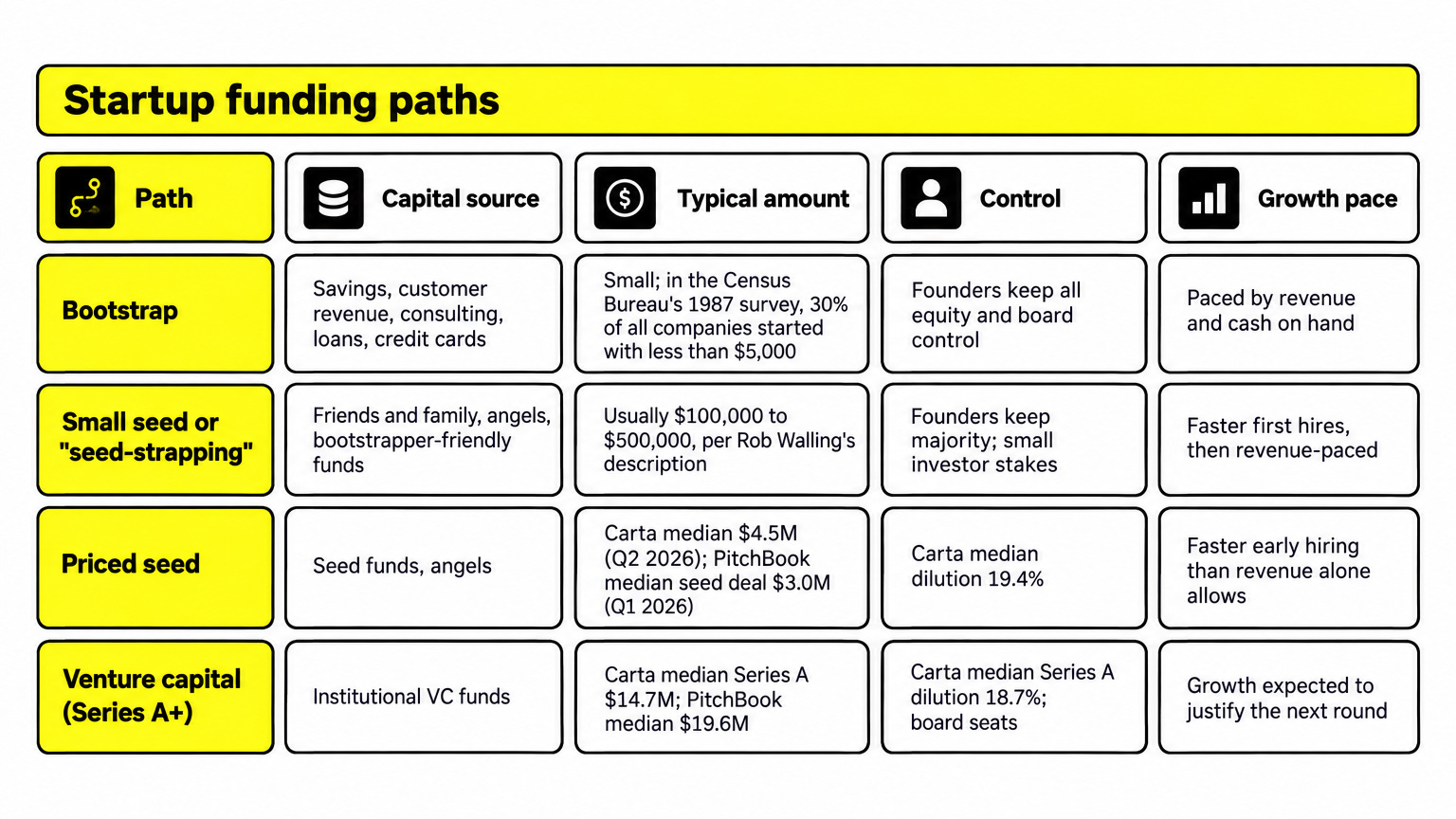
Path: Bootstrap
Capital source: Savings, customer revenue, consulting, loans, credit cards
Typical amount: Small; in the Census Bureau’s 1987 survey, 30% of all companies started with less than $5,000
Control: Founders keep all equity and board control
Growth pace: Paced by revenue and cash on hand
Path: Small seed or “seed-strapping”
Capital source: Friends and family, angels, bootstrapper-friendly funds
Typical amount: Usually $100,000 to $500,000, per Rob Walling’s description
Control: Founders keep majority; small investor stakes
Growth pace: Faster first hires, then revenue-paced
Path: Priced seed
Capital source: Seed funds, angels
Typical amount: Carta median $4.5M (Q2 2026); PitchBook median seed deal $3.0M (Q1 2026)
Control: Carta median dilution 19.4%
Growth pace: Faster early hiring than revenue alone allows
Path: Venture capital (Series A+)
Capital source: Institutional VC funds
Typical amount: Carta median Series A $14.7M; PitchBook median $19.6M
Control: Carta median Series A dilution 18.7%; board seats
Growth pace: Growth expected to justify the next round
The Census figure comes from Amar Bhidé’s book excerpt. The small-seed range comes from the sample chapter of Walling’s The SaaS Playbook.
Carta’s figures come from its Round Benchmarking Tool. Carta describes its dataset as about 20,000 equity rounds raised by U.S.-based startups since 2021.
PitchBook’s figures come from the Q1 2026 Venture Monitor. The two datasets disagree because they cover different samples.
Funding stories blur three numbers, and the case studies below keep them apart:
Capital raised: New money the company sells shares for, which lands on its balance sheet.
Capital spent: What the company burns. Linear says it has “more cash in the bank than we have raised from investors,” so its spending came from revenue.
Secondary sales: Existing shareholders sell to new investors, and the company receives nothing. Zapier’s 2021 $5 billion valuation and Atlassian’s 2010 Accel deal were mostly or entirely secondary.
Pros and cons of bootstrapping
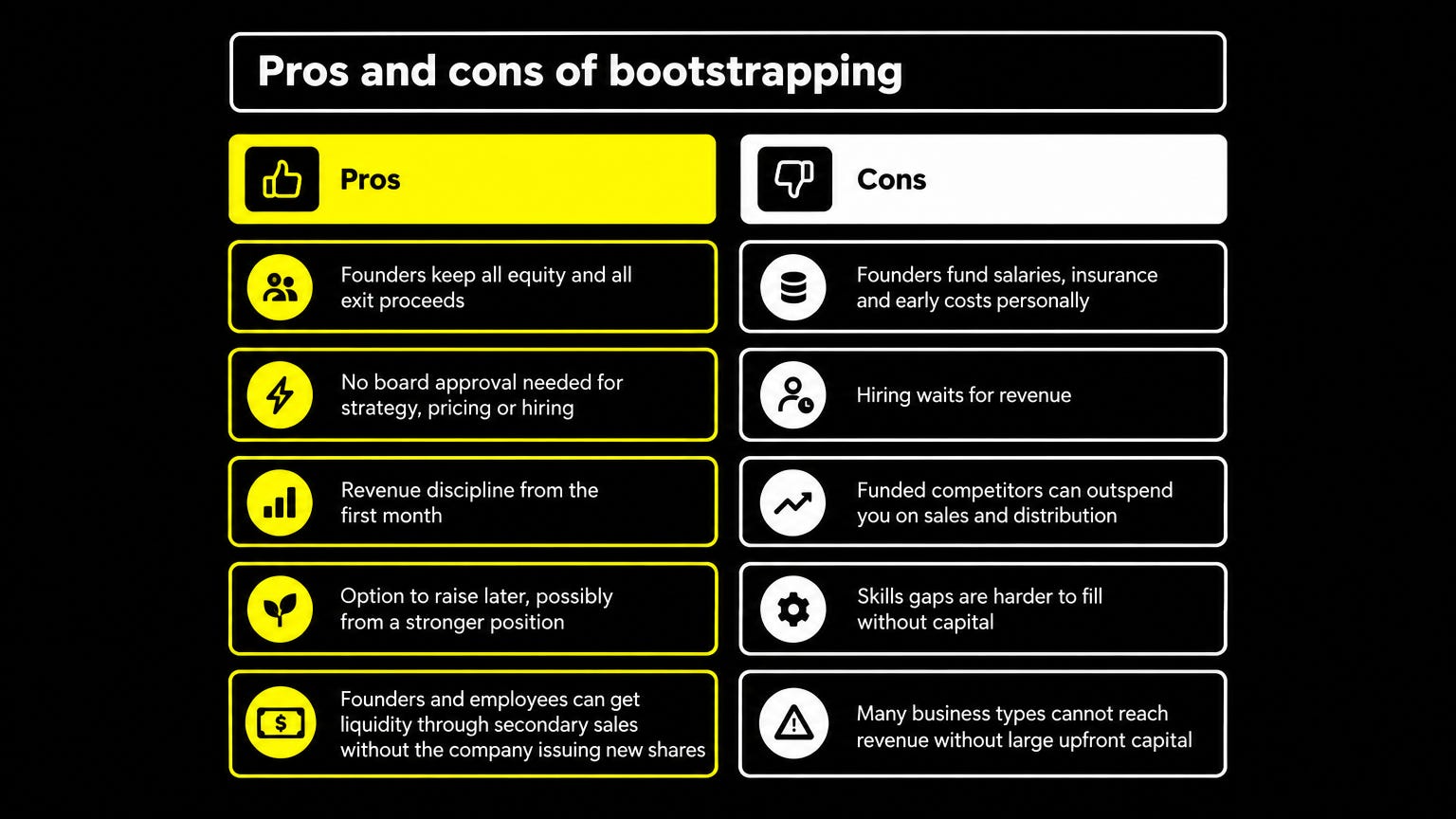
Bootstrapping keeps ownership and decision rights with the founders, and it forces the business to earn its own growth. The cost is that the founders carry the financial risk and grow at the speed revenue allows.
Pros: Founders keep all equity and all exit proceeds
Cons: Founders fund salaries, insurance and early costs personally
Pros: No board approval needed for strategy, pricing or hiring
Cons: Hiring waits for revenue
Pros: Revenue discipline from the first month
Cons: Funded competitors can outspend you on sales and distribution
Pros: Option to raise later, possibly from a stronger position
Cons: Skills gaps are harder to fill without capital
Pros: Founders and employees can get liquidity through secondary sales without the company issuing new shares
Cons: Many business types cannot reach revenue without large upfront capital
What founders keep: control, equity and bargaining position
Ownership is the most measurable benefit. Forbes reported that Mailchimp co-founders Ben Chestnut and Dan Kurzius each held 50%, and estimated each would be worth $5 billion after taxes from the Intuit sale. That figure is Forbes’ estimate, not a company disclosure.
Control shows up in choices that would be hard to defend to a board. Linear’s CEO Karri Saarinen wrote that the company was built “without running a single A/B test and without chasing metrics or looking to data for answers. We didn’t do SEO and growth hacks. We’ve grown the team slowly and intentionally.”
Jason Fried of 37signals, a company that reports being profitable every year since 1999 without institutional venture capital, answered a question about its valuation with “I don’t know and I don’t care.”
Profitability also changes the question investors ask. Accel quotes Saarinen on what profit did for Linear’s fundraising: “Being profitable doesn’t mean you have to be anti-investors. It means you have that choice…you can raise more, less, or nothing.”
The claim that bootstrapped companies get better terms when they raise is plausible but weakly evidenced. I found no dataset or peer-reviewed study that compares valuation, dilution or control terms for profitable or bootstrapped companies against other companies at the time of a raise.
A 2026 SSRN abstract calls bootstrapped startups a “substantial yet under-studied” category. Cooley’s and Carta’s deal-term reports are market-wide and do not split by profitability.
The evidence that does exist is anecdotal. Atlassian’s 2010 and 2014 transactions were secondary, so the company sold no new shares. President Jay Simons said of the 2014 round, “None of the money has actually gone to Atlassian’s bank account.”
Qualtrics founder Ryan Smith declined a $500 million cash offer in 2012, according to the Deseret News. Linear’s 2026 tender priced the company at $2.5 billion without selling primary shares.
These show what a profitable company can choose. They do not prove it got better terms than an unprofitable peer would have.
What it costs: personal risk, slower growth and burnout
The founder pays first. The Sydney Morning Herald reported that Atlassian started “on a $10,000 credit card debt” and that for the first three years Mike Cannon-Brookes and Scott Farquhar “pumped all earnings into the business and were surviving off their university scholarship money of about $300 a week.”
Braintree’s Bryan Johnson described his situation before starting the company: “I was broke, up to my eyeballs in debt, and I had no way to make money because nobody would hire me”.
In the U.S., health insurance is a fixed personal cost that a job used to cover. KFF reports that ACA Marketplace insurers raised premiums 26% on average for 2026. Average Marketplace deductibles reached a record $3,786 in 2026.
Hiring waits for cash. Tom Preston-Werner said in a 2010 Hacker News AMA that at GitHub “We only hired when we had the money to do so.” Co-founder Scott Chacon put a timeline on it: “We worked on GitHub for almost a year before we were making enough revenue to hire another developer.”
Skills gaps hurt more without money to hire around them. Quartz reported an analysis of 200 founder post-mortems: bootstrapped companies cited inexperience or a skills gap as a failure reason 15% of the time, against 3% for funded companies. The article does not name the researchers or the study period.
Paying work also competes with the product. Paul Graham, answering which distractions hurt a startup most, wrote: “The worst type are those that pay money: day jobs, consulting, profitable side-projects. The startup may have more long-term potential, but you’ll always interrupt working on it to answer calls from people paying you now.”
Some founders who bootstrapped later advised against it. A 2021 Australian Financial Review interview ran under the headline “Atlassian’s Scott Farquhar tells founders not to bootstrap”. It reported that he spent the first 10 years building without external venture funding.
I found no sourced burnout rates comparing bootstrapped and funded founders, so I will not quote one.
How to decide: bootstrap, seed or venture capital
Score your business on six factors. If most factors favor bootstrapping or a small seed round, start there. If most favor venture capital, plan to raise from the start.
Factor: Capital needed before revenue
Leans bootstrap: Under a few months of founder costs
Leans small seed: One year of a small team
Leans venture capital: Millions to billions (trials, fabs, tooling)
Factor: Time to first revenue
Leans bootstrap: Weeks to months
Leans small seed: Within a year
Leans venture capital: Years, gated by regulators or manufacturing
Factor: Winner-take-all risk
Leans bootstrap: Many viable players
Leans small seed: Some advantage to speed
Leans venture capital: Network effects reward scale; rivals subsidize users
Factor: Gross margins
Leans bootstrap: High software margins
Leans small seed: High, but needs a team to build
Leans venture capital: Low early margins, or heavy unit costs
Factor: Founder risk tolerance
Leans bootstrap: Low appetite for dilution and board oversight
Leans small seed: Accepts small dilution for speed
Leans venture capital: Accepts large dilution and board control
Factor: Personal runway
Leans bootstrap: Savings or income cover 12+ months
Leans small seed: Savings cover less than a year
Leans venture capital: Founders cannot self-fund at all
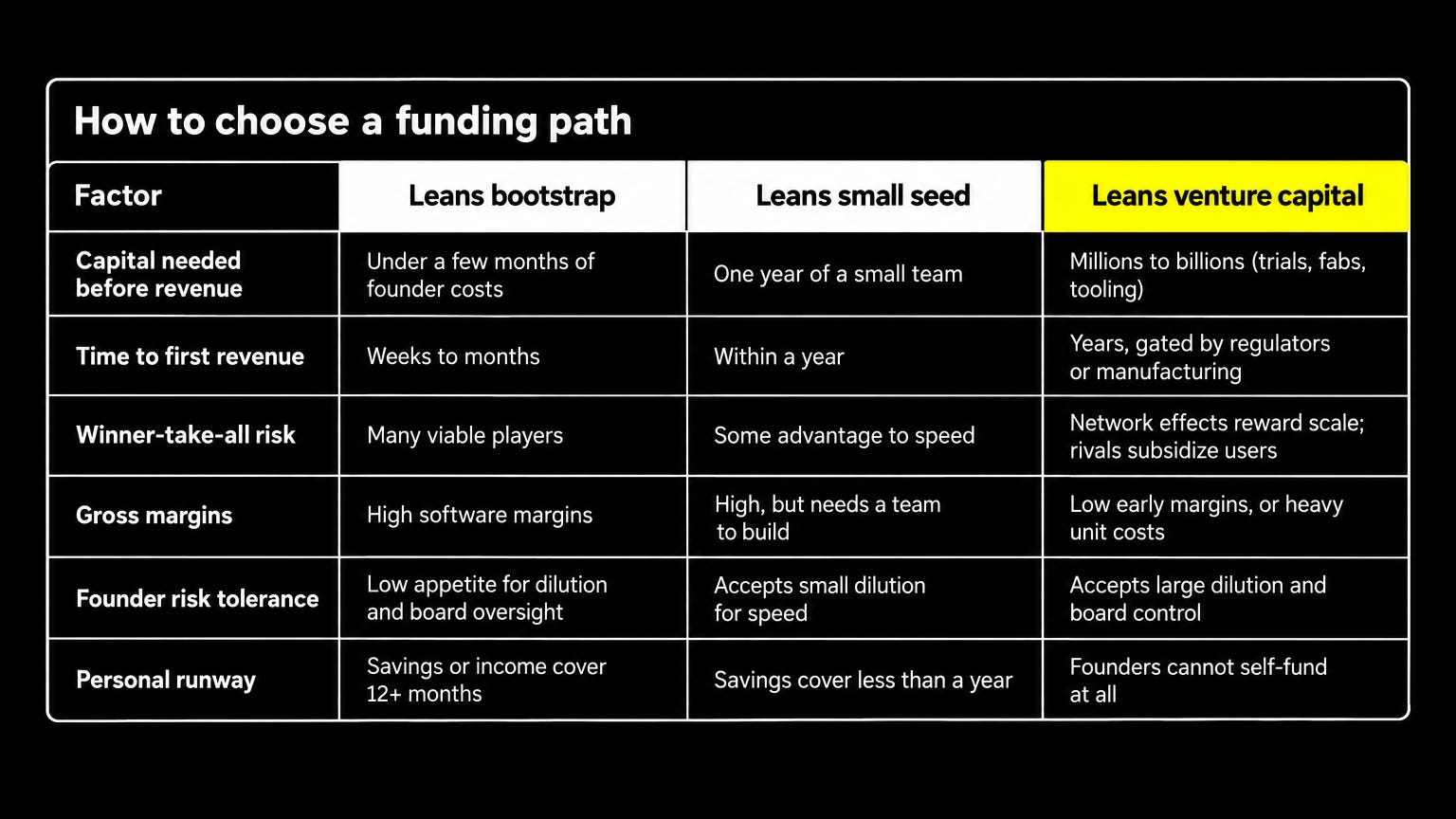
Two factors override the rest. If the product cannot be sold until a regulator approves it, bootstrapping is off the table. If a competitor can buy your market with subsidies, revenue-paced growth may arrive too late.
Businesses that are a bad fit for bootstrapping
Drug development, medical devices, semiconductors, hardware, deep tech and network-effect marketplaces need capital measured in millions or billions before customers pay. The figures below come from peer-reviewed research, industry associations and public filings.
Drugs and biologics: The median capitalized R&D investment to bring a new drug to market was $985.3 million, counting failed trials, across 63 drugs approved from 2009 to 2018. Because only public data was used, the sample leaned toward smaller firms and orphan drugs. BIO’s analysis of 2011–2020 programs found a 7.9% chance that a Phase I candidate reaches approval, and an average of 10.5 years from Phase I to approval.
Medical devices: A 2010 industry survey, as summarized by Complizen, put the average 510(k) device at $31 million from concept to clearance and a PMA device at $94 million. These are survey estimates, not audited costs.
Semiconductors: The Congressional Research Service reports that designing and prototyping 5 nm chips cost about $542 million in 2020, up from about $51 million for 28 nm chips in 2011. The Semiconductor Industry Association estimates a new fab at roughly $5 billion to $20 billion.
Hardware and EVs: Rivian’s S-1 shows an accumulated deficit of $2,680 million at June 30, 2021. Its 2023 annual report shows $18,558 million at December 31, 2023.
Deep tech: BCG found that deep tech startups have consumed 48% more funding than regular startups by the time they reach $5 million in revenue, and take 35% longer to grow from $1 million to $5 million. McKinsey says first-of-a-kind production facilities often require €50 million to €200 million.
Network-effect marketplaces: Lyft recorded $1.4 billion of driver and rider incentives as a reduction to revenue in 2022. Uber reported an accumulated deficit of $32.9 billion as of March 31, 2023. The New York Times reports it raised nearly $20 billion in venture capital before going public.
Network effects deserve a caveat. Andy Wu and David Yoffie’s HBR note on nascent platforms lists the conditions behind a hard chicken-or-egg problem: “strong network effects, high multi-homing costs, limited differentiation, and high other barriers to entry”.
A marketplace that lacks those conditions may not need a subsidy war. I found no source that quantifies the capital needed to win one.
How GitHub, Braintree, Zapier and Linear actually financed growth
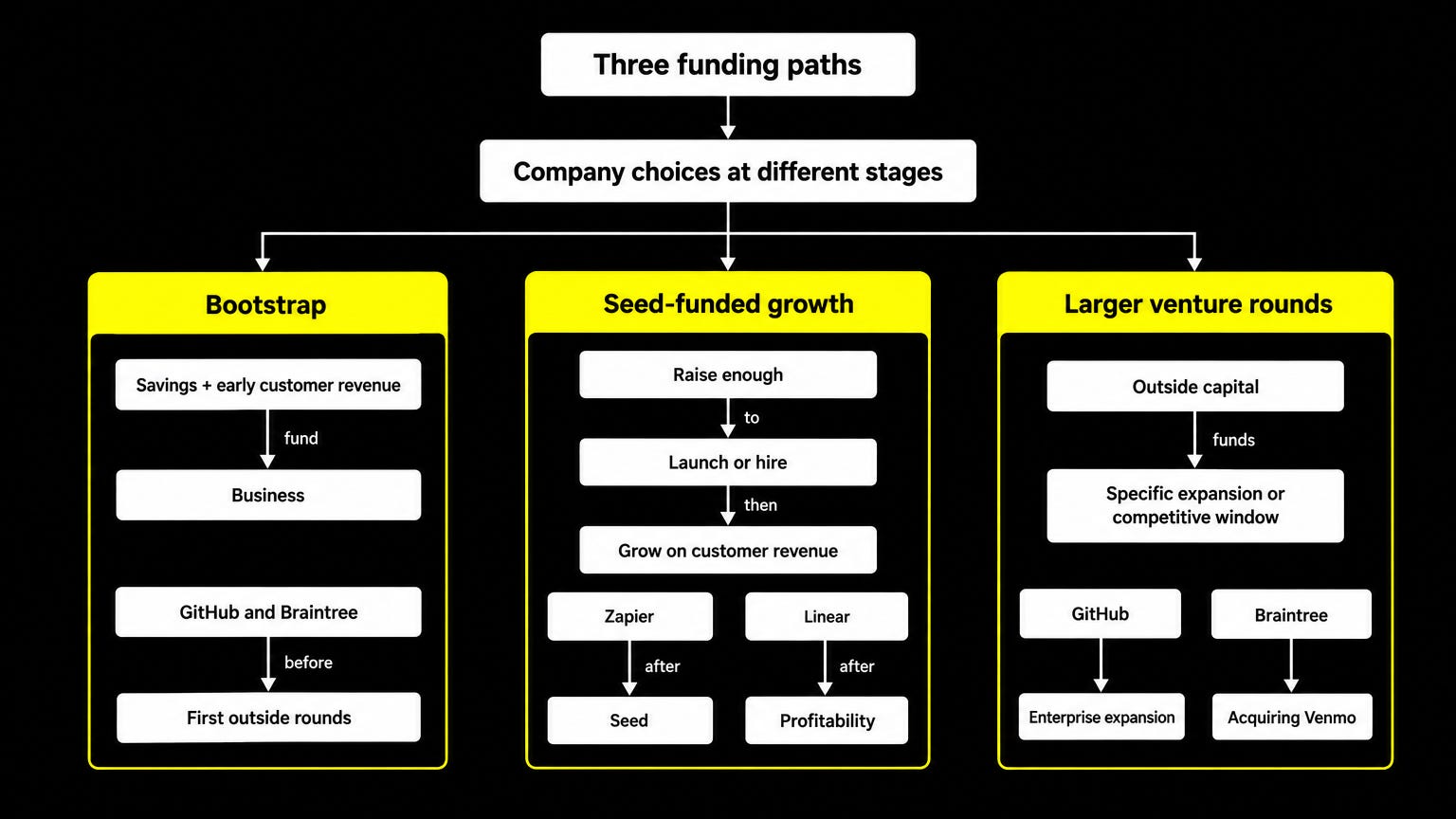
The four core companies share a pattern. They built a product people paid for and reached profitability or near it on little or no outside money. They later raised from a position where the money was optional or aimed at a specific expansion. Their timelines and amounts differ.
GitHub
GitHub was self-funded for about four years and five months, from its February 8, 2008 founding to its first outside round on July 9, 2012. Preston-Werner says work started in late 2007.

GitHub logo via GitHub Brand Toolkit.
First product and customers. GitHub was a hosted Git service with paid plans. When it launched publicly on April 10, Preston-Werner wrote, the company was “still just three 20-somethings without a single penny of outside investment.” That same post is titled “How I Turned Down $300,000 from Microsoft to go Full-Time on GitHub.”
Money in. In 2010 Preston-Werner wrote that the founders “only invested a few thousand dollars out of our own pockets during the first months to cover legal fees.”
About one year in: GitHub made enough to pay low salaries for the three co-founders and hire Scott Chacon, going “from zero to four full time salaries in one day,” per Preston-Werner’s AMA.
October 2008: The company had four full-time employees and “a grand total of $0 in venture capital or other outside investment”.
About 18 months: Preston-Werner said “about 18 months after inception we were making decent salaries.”
October 2010: A team of thirteen had signed up over 420,000 developers.
2011: The company had grown “from four people to twenty-six” with no outside funding.
July 2012: Over 100 people, with revenue growing nearly 300% annually and profitable nearly the entire way, per a16z.
No primary source gives an absolute revenue or profit figure before 2012. The a16z figure is a growth rate.
The 2012 round. Reuters reported a $100 million round led by Andreessen Horowitz, “marking GitHub’s first outside investment,” with SV Angel participating and a16z partner Peter Levine joining the board. The Verge reported that 99% of the money came from a16z.
The Wall Street Journal reported a $750 million valuation from an unidentified source. The company did not confirm it.
Why it raised. GitHub told Reuters the cash would help it “expand faster and better compete with companies such as Sydney-based Atlassian.” Levine said it would build marketing and sales capability. Preston-Werner told TechCrunch the money would develop GitHub Enterprise, “a server side version of GitHub.com”.
Yahoo Finance, citing Business Insider, wrote that the founders “didn’t need the money and agonized over taking it”.
The 2015 round. GitHub raised $250 million led by Sequoia, with a16z, Thrive Capital and IVP. That brought total outside funding to $350 million. The Wall Street Journal reported a valuation of about $2 billion from sources.
Chris Wanstrath explained the purpose: “The round is not just to accelerate, but also to allow us to think bigger and take larger risks.” Bloomberg reported GitHub doubled headcount to 600 over about 18 months after the round.
The exit. Microsoft announced on June 4, 2018 that it would acquire GitHub “for $7.5 billion in Microsoft stock”. Later filings describe the deal as “a $7.5 billion stock transaction (inclusive of total cash payments of $1.3 billion in respect of vested GitHub equity awards and an indemnity escrow),” closed October 25, 2018.
CNBC reported, from one unnamed person, that Microsoft paid 25 times revenue, implying about $300 million in annual revenue. That is unconfirmed.
Price versus operating success. The $7.5 billion is what Microsoft paid in its own stock. The operating record is the four profitable years before 2012 and the $1 billion ARR Satya Nadella reported in 2022.
The 2012 and 2015 money went into enterprise sales, international expansion and a team that doubled after 2015. The capital paid for GitHub Enterprise and the marketing and sales capability Levine described.
Braintree
Braintree was bootstrapped from its 2007 founding until June 2011, about four years. It then raised two rounds, bought Venmo, and sold to eBay in 2013.

Braintree logo via PayPal Newsroom.
First product and customers. Bryan Johnson found the opportunity while selling credit card processing door to door. He described an early OpenTable deal of “$1.4 million over three years, $30,000 a month,” plus a “$98,000 signup bonus,” which paid for three software engineers and made the company “profitable from day one”.
Funding stance. Johnson told Tim Ferriss that after moving toward software, “we were pouring back all the cash back into the business because I was bootstrapping. I had not taken any outside capital and so it was a huge decision on what to do.”
In the same interview he put net income at “something like – I do not know. $200,000.00 net income a year,” without a stated period.
Pre-raise metrics. Johnson is quoted on a third-party blog saying “By year four we were around like 4 to 6 million thereabouts,” with no metric named. Vanity Fair says that in 2011 the company had “about 40 employees and a few million dollars in annual revenue”. The revenue figure is not confirmed by a primary source.
At the 2011 round, the reported metrics were:
Payment volume: A “$3 billion run rate in payment volume from over 2,000 merchants,” and profitable.
Growth: A compounded growth rate “in excess of 600% since inception” and over 150% expected revenue growth in 2011, per the same report.
Headcount: 30 people per Accel, 32 per the Chicago Tribune, and about 40 per Vanity Fair.
Distribution. TechCrunch reported that 99% of Braintree’s business came from word-of-mouth and that it had no outbound sales reps. Accel partner Ryan Sweeney, quoted by VentureBeat, described how Accel found it: “Braintree caught our attention when we realized the vast majority of our portfolio companies were turning to them for payments”.
The 2011 round. Braintree raised $34 million from Accel, its first institutional money (Accel’s own page says $32 million). Sweeney summarized the company for TechCrunch: “The company is growing, profitable and bootstrapped.” Johnson said the cash would go to hiring engineers and expanding sales and marketing.
Vanity Fair says Johnson “took a multimillion-dollar payout and kept a stake in the business,” so part of the transaction benefited the founder directly. No source breaks out the split.
Why it raised. Johnson’s statement in the press release framed it as an industry bet: “We believe that the industry will consolidate dramatically and payments will be bundled with a larger set of services.” Months later, Accel entrepreneur-in-residence Bill Ready became CEO and Johnson stayed as chairman.
What capital enabled. Braintree bought Venmo for $26.2 million in August 2012. Crain’s wrote that the 2011 venture money “helped provide Braintree the ammunition” for the purchase.
In October 2012, NEA led a $35 million round with Accel, RRE and Greycroft. The money was to build product, hire engineers in the Bay Area, New York and Chicago, and expand internationally. Total funding is reported as $69 million or $70 million depending on the outlet.
The exit. eBay announced it would acquire Braintree “for total consideration of approximately $800 million in cash”. eBay’s 2013 10-K reports “total consideration of approximately $713 million, consisting primarily of cash,” with closing on December 19, 2013. The filings do not explain the $87 million gap.
At the sale, Reuters reported Braintree expected about $12 billion in payment volume that year. The Chicago Tribune reported about 200 employees, up from 60 the year before.
Braintree’s lesson is that bootstrapping got it to a profitable, word-of-mouth business at a $3 billion volume run rate. Venture money then bought speed in a consolidating market: an acquisition, a larger team, and a professional CEO. The Chicago Tribune reported headcount of about 200 at the sale, up from 60 a year earlier.
Zapier
Zapier raised one seed round in 2012, reached profitability by 2014, and has not raised primary capital since. Its $5 billion valuation in 2021 came from a secondary sale.
Zapier logo via Zapier Newsroom.
Founding and seed. Wade Foster, Mike Knoop and Bryan Helmig started Zapier in Columbia, Missouri. YC lists the founding year as 2011 and Zapier’s newsroom says 2012. Wikipedia says YC initially rejected them; they reapplied and joined the Summer 2012 batch.
The YC profile says the company “raised our only round of funding, $1.3 million in seed funding from YC and Bessemer Venture Partners.” TechCrunch reported the October 2012 round as $1.2 million from Bessemer, Draper Fisher Jurvetson, Wufoo co-founder Kevin Hale and other angels.
Profitability. Zapier’s blog says the company “has been profitable since 2014 and holds zero debt” and that “outside of our seed round in 2012, we’ve never had to raise money.” A 2017 Yahoo Finance article said 2013 instead. The company’s own date is 2014.
Remote operations. Zapier has been fully remote since its founding in October 2011, per its remote-work ebook. Knoop explained the communication trade-off: “Non-remote work defaults to the highest distraction communication first, which is in-person. Remote work defaults to the lowest, which is no communication.” Zapier has no offices and employs staff in about 40 countries.
Headcount and revenue grew on internal cash:
April 2017: “80+ employees, all remote, across 13 countries and 22 states,” per Foster.
March 2020: Around 300 employees.
June 2020: Over 500 people, per Zapier. A March 2021 TechCrunch interview gives 400 workers, which conflicts.
Summer 2020: Crossed $100 million ARR, per Foster.
March 2021: $140 million in recurring revenue.
2023 to 2026: Over 800 teammates in January 2023; 800 per Built In in August 2026.
Later revenue figures are third-party estimates. Sacra estimated $310 million ARR at the end of 2023. A valuation-comparison article cites trackers at around $420 million for 2026 and calls it “an unverified estimate”.
The 2021 secondary. Zapier’s newsroom states: “Without any further funding, we were valued at $5 billion in 2021.” Forbes reported that Sequoia and Steadfast bought shares, that “The amount sold and sellers were not disclosed,” and that none of the founders participated.
The Information‘s snippet said the price “appears to have surpassed $4 billion, which would be at least 40 times its annualized revenue”. A job listing names the second buyer as Steadview Capital rather than Steadfast. No source reconciles the two names.
No source discloses any primary capital in the 2021 deal. The only primary money anyone identifies is the 2012 seed. The $5 billion figure measures what outside investors paid early shareholders for a slice, not money Zapier received or spent.
Zapier’s distinct lesson is the small seed as launch capital. Zapier took one seed round of about $1.3 million, has been profitable since 2014, and has raised no primary capital since.
Linear
Linear raised a $4.2 million seed ten months after founding and became profitable about a year after launch. It then raised three more times. At the 2023 Series B, Saarinen said the company didn’t need the money.

Linear logo via Linear Brand Guidelines.
First product and customers. Linear is an issue tracker for software teams. Sequoia’s company page says the ambition was “a Jira 2.0”. When the seed closed in November 2019, Linear was in private beta with a waitlist, had “picked up hundreds of companies,” and had four employees.
Saarinen wrote that after a year in private beta, “almost all of our 100 beta users converted to paid customers”.
Funding timeline. The seed was led by Sequoia with Index Ventures. Sequoia led a $13 million Series A in December 2020. Neither valuation is public.
Profitability. Saarinen wrote: “Twelve months after launch, we hit profitability, and we’ve stayed profitable ever since.” Sequoia says the company was founded in January 2019 and “was profitable by July 2021.” The Pragmatic Engineer reports that the first profitable month came two years after founding.
Series B. Accel led a $35 million round in September 2023 with Sequoia and 01Advisors. Forbes reported a valuation of about $400 million from three sources.
Saarinen’s announcement described the company’s cash position: “Linear has been growing & operating profitably since 2021, a year after launching the product. We also have a negative lifetime burn rate (we have more cash in the bank than we have raised from investors).” The team was 50 people.
Why it raised. Asked why Linear raised at all, Saarinen told Forbes: “Over the last three years, many companies raised money, but we didn’t really need it.” Accel’s statement on the Series C shows what happened to the money: “Linear hasn’t touched its Series A or B funds, and adds to its cash balance by operating profitably month over month.”
Series C and tenders. Linear raised $82 million at a $1.25 billion valuation in June 2025. Saarinen wrote that “The round includes both primary and secondary funding, led by Accel with continued support from Sequoia and 01A”. TechCrunch reported about 80 employees and $134.2 million raised to date per Crunchbase.
In August 2026, Linear completed a $99 million tender at $2.5 billion so current and former employees could sell vested shares. By my arithmetic, the tender was about 4% of the valuation. Saarinen explained why the company sold no new shares: “We are cashflow positive, and have more cash in the bank than everything we have raised to date. Raising more primary capital would have meant diluting the team and our shareholders without a clear reason; so we chose a different path.”
Distribution. Linear grew through product-led adoption. Forbes reported it spent $36,000 on marketing and, until recently, employed one salesperson. By 2026, Linear said it had passed $100 million ARR, more than 40,000 companies paid for it, and net revenue retention was 177%.
Headcount. The team was four at the seed, 50 at the Series B, 70 in January 2025, and 118 in January 2026, per Saarinen’s X post.
Linear is the clearest example of a seed-funded company that used later rounds as a balance-sheet reserve and liquidity for employees rather than operating fuel. Saarinen described the post-raise routine: “The truth is, not much changes after a raise. We go back to building.”
Mailchimp, Atlassian and Qualtrics
These three add lessons the core four do not. Mailchimp never raised, Atlassian used secondary rounds and an IPO, and Qualtrics bootstrapped for a decade before raising heavily.
Mailchimp: never raising at all. Ben Chestnut and Dan Kurzius founded Mailchimp in 2001 with no outside funding, per the company. Forbes reported $600 million in revenue in 2018. Intuit cited approximately $800 million in unaudited 2020 revenue, up 20%.
Ben Chestnut, Mailchimp co-founder. Photo by Eóin Noonan / Collision via Sportsfile, CC BY 2.0.

Intuit closed the acquisition on November 1, 2021. It paid approximately $5.7 billion in cash and 10.1 million Intuit shares with a fair value of approximately $6.3 billion. By my arithmetic, Mailchimp stayed independent for about 20 years.
The lesson: in a market without a subsidy war, a bootstrapped company can compound for two decades and the founders keep the full outcome.
Atlassian: secondary rounds as founder and employee liquidity. The company page says the founders were “Armed with a credit card and a dream”. TechCrunch reported that co-founder Mike Cannon-Brookes said the company had been “profitable from Year One” and that revenue was $59 million in the fiscal year ended June 30, 2010.
Mike Cannon-Brookes, Atlassian co-founder. Photo by Atlassian, CC0 1.0.

Accel invested $60 million in July 2010. A later TechCrunch article said the financing “was primarily secondary”, and the SMH reported a $400 million valuation. Accel’s own write-up described 29% growth and 30% cash flow margins at investment, and said “Three quarters before we invested, the Y-o-Y quarterly growth rate slowed to an anemic 5%.”
Atlassian priced its IPO at $21 in December 2015, selling $462 million of new shares. Bloomberg put the market value at the IPO price at about $4.4 billion.
The lesson: a profitable company can bring in an institutional investor without new primary money, and the first big primary raise can be the IPO.
Qualtrics: ten years bootstrapped, then accelerate. Qualtrics was formed in 2002 and was bootstrapped for its first 10 years. Ryan Smith described the operating rule at Disrupt 2015: “You really have to kind of be blunt, eat what you kill”.
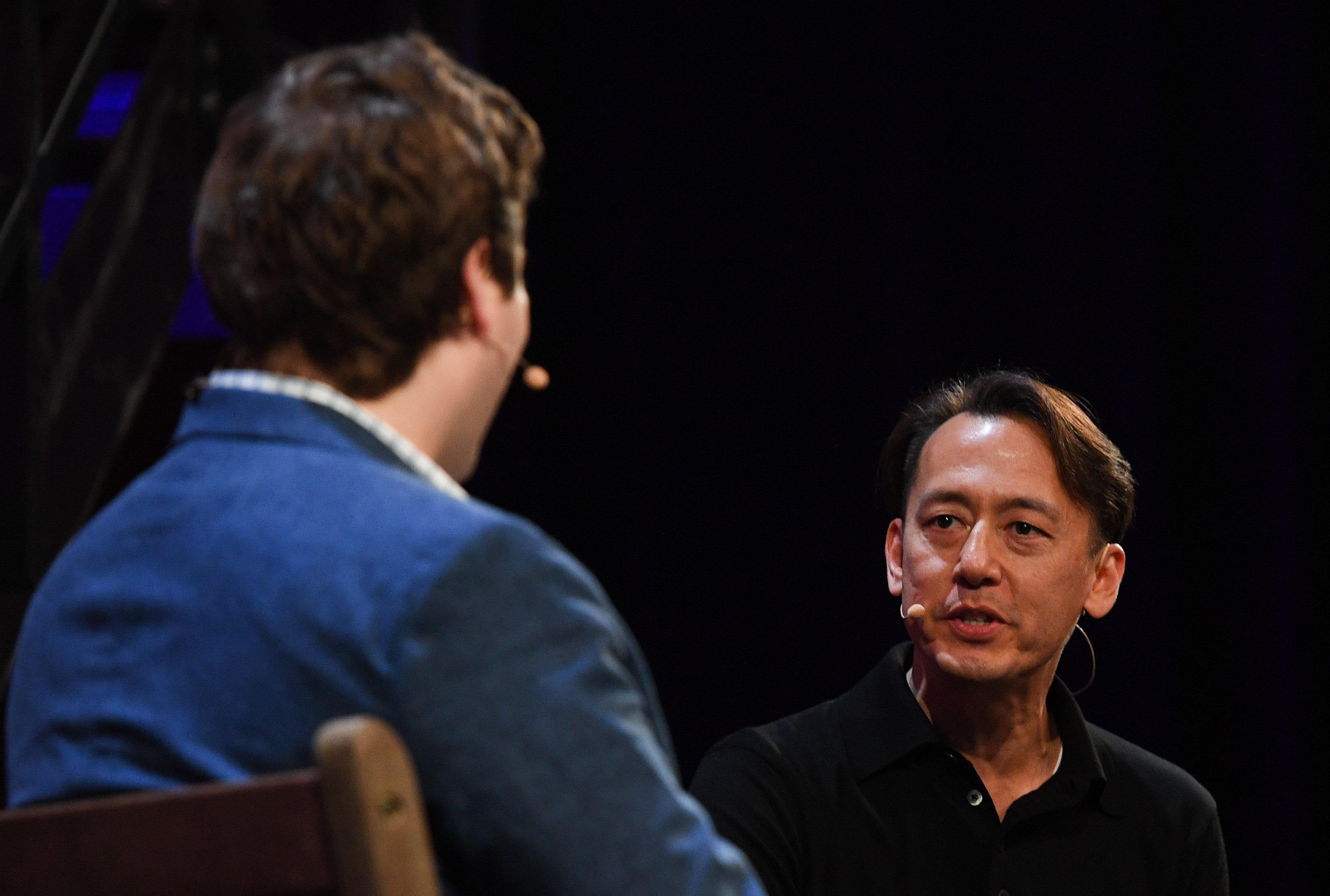
Ryan Smith, Qualtrics co-founder. Cropped video still by Salt City FC, CC BY 3.0.

A 2017 TechCrunch interview says Qualtrics hit $50 million a year in revenue, $30 million of it profit, before investors came in. Sequoia’s account says $30 million in revenue doubling each year, which conflicts.
Accel and Sequoia invested $70 million in May 2012, followed by a $150 million Series B in 2014. SAP agreed to buy Qualtrics for $8 billion in cash in November 2018, pre-empting an IPO. SAP later took it public in 2021 at $30 per share. Silver Lake and CPP Investments took it private in 2023 at about $12.5 billion in equity value.
The lesson: bootstrapping can build a large profitable base, and late venture money then funds an aggressive push toward an exit.
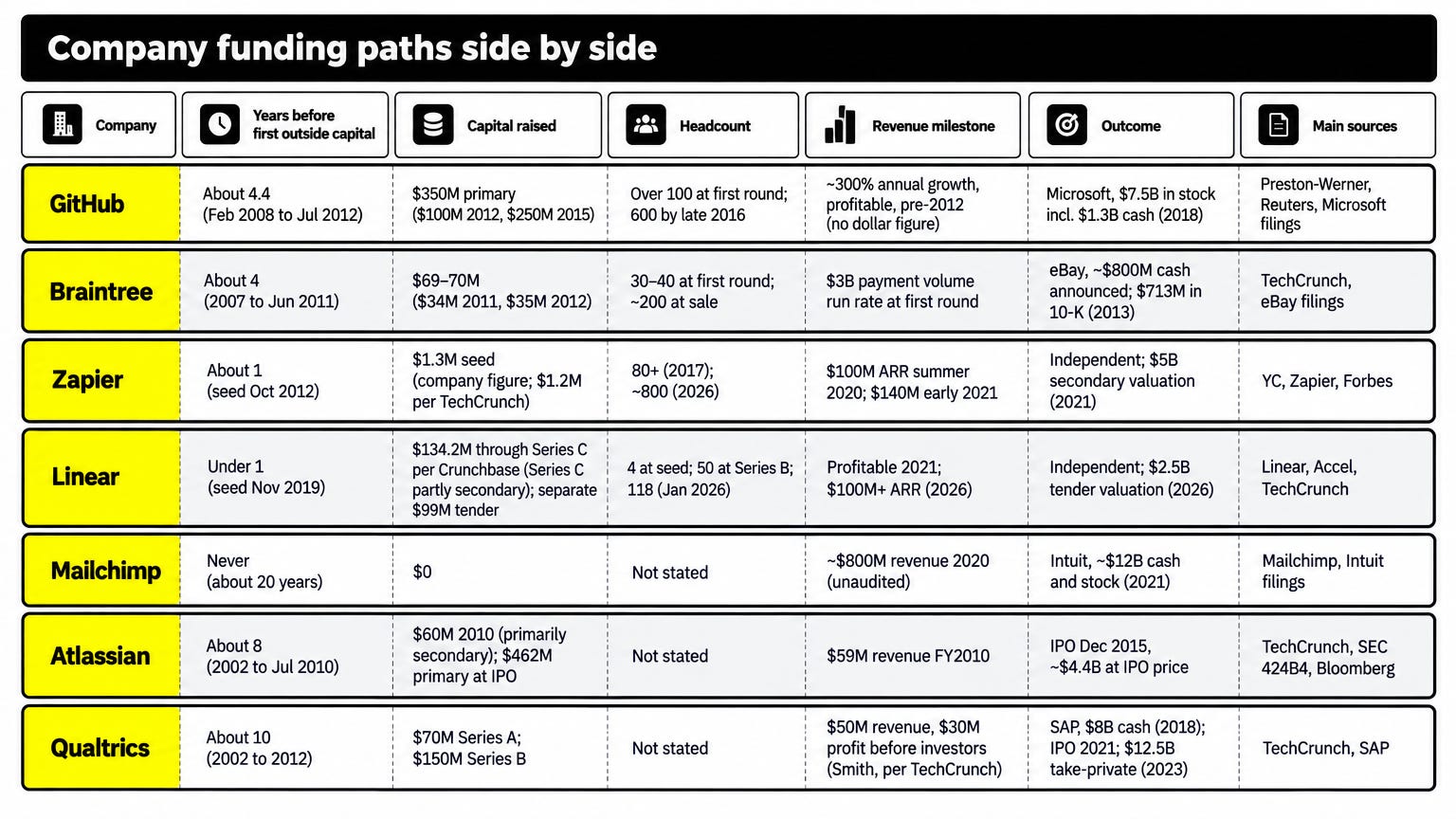
The paths side by side
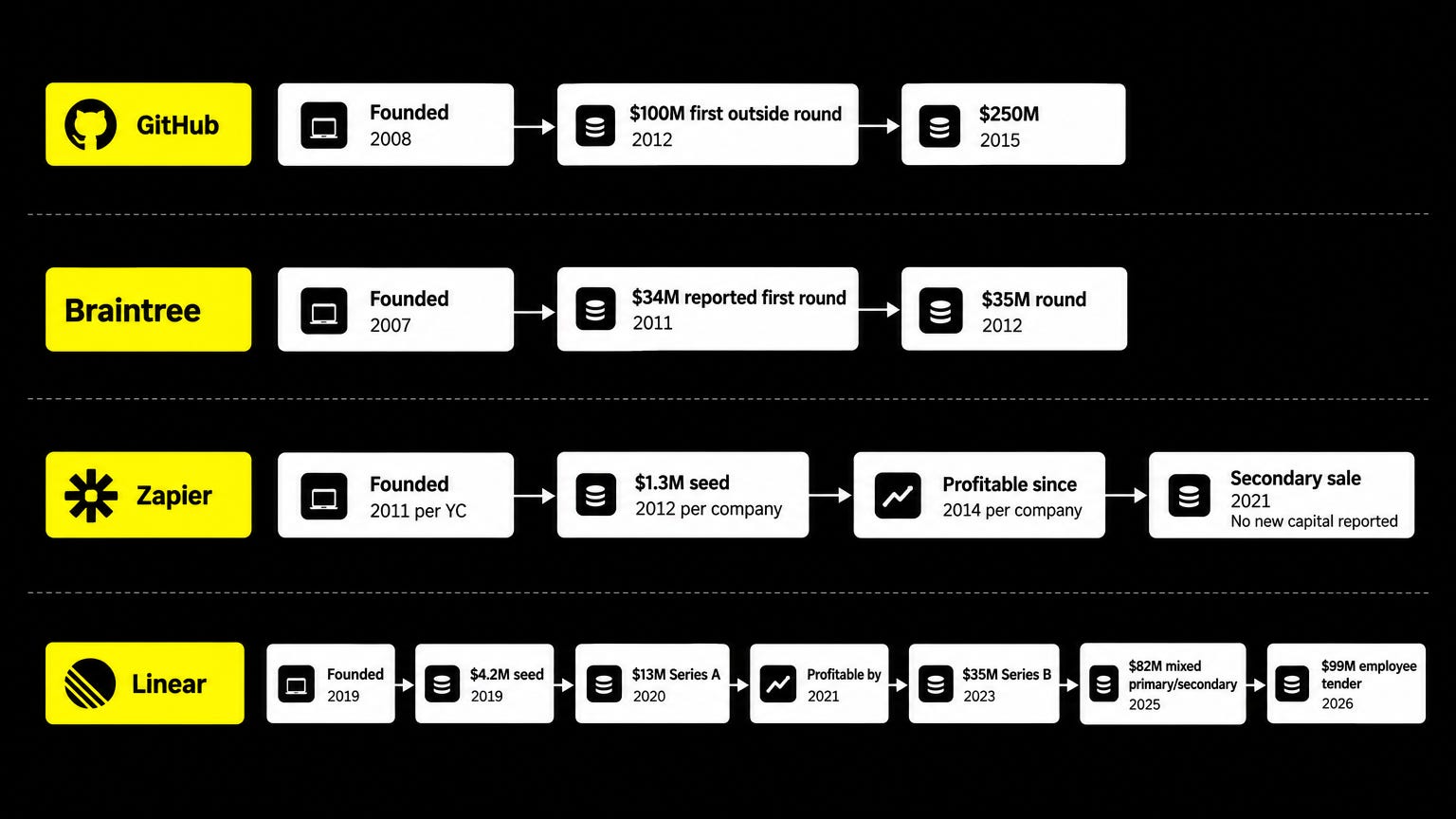
“Capital raised” counts outside rounds, with secondary portions noted.
Company: GitHub
Years before first outside capital: About 4.4 (Feb 2008 to Jul 2012)
Capital raised: $350M primary ($100M 2012, $250M 2015)
Headcount: Over 100 at first round; 600 by late 2016
Revenue milestone: ~300% annual growth, profitable, pre-2012 (no dollar figure)
Outcome: Microsoft, $7.5B in stock incl. $1.3B cash (2018)
Main sources: Preston-Werner, Reuters, Microsoft filings
Company: Braintree
Years before first outside capital: About 4 (2007 to Jun 2011)
Capital raised: $69–70M ($34M 2011, $35M 2012)
Headcount: 30–40 at first round; ~200 at sale
Revenue milestone: $3B payment volume run rate at first round
Outcome: eBay, ~$800M cash announced; $713M in 10-K (2013)
Main sources: TechCrunch, eBay filings
Company: Zapier
Years before first outside capital: About 1 (seed Oct 2012)
Capital raised: $1.3M seed (company figure; $1.2M per TechCrunch)
Headcount: 80+ (2017); ~800 (2026)
Revenue milestone: $100M ARR summer 2020; $140M early 2021
Outcome: Independent; $5B secondary valuation (2021)
Main sources: YC, Zapier, Forbes
Company: Linear
Years before first outside capital: Under 1 (seed Nov 2019)
Capital raised: $134.2M through Series C per Crunchbase (Series C partly secondary); separate $99M tender
Headcount: 4 at seed; 50 at Series B; 118 (Jan 2026)
Revenue milestone: Profitable 2021; $100M+ ARR (2026)
Outcome: Independent; $2.5B tender valuation (2026)
Main sources: Linear, Accel, TechCrunch
Company: Mailchimp
Years before first outside capital: Never (about 20 years)
Capital raised: $0
Headcount: Not stated
Revenue milestone: ~$800M revenue 2020 (unaudited)
Outcome: Intuit, ~$12B cash and stock (2021)
Main sources: Mailchimp, Intuit filings
Company: Atlassian
Years before first outside capital: About 8 (2002 to Jul 2010)
Capital raised: $60M 2010 (primarily secondary); $462M primary at IPO
Headcount: Not stated
Revenue milestone: $59M revenue FY2010
Outcome: IPO Dec 2015, ~$4.4B at IPO price
Main sources: TechCrunch, SEC 424B4, Bloomberg
Company: Qualtrics
Years before first outside capital: About 10 (2002 to 2012)
Capital raised: $70M Series A; $150M Series B
Headcount: Not stated
Revenue milestone: $50M revenue, $30M profit before investors (Smith, per TechCrunch)
Outcome: SAP, $8B cash (2018); IPO 2021; $12.5B take-private (2023)
Main sources: TechCrunch, SAP
What these histories prove and what they don’t
These seven histories prove that a company can reach large scale on revenue or a small seed, then raise from strength. They do not prove that bootstrapping is the better path on average, because the sample is made of survivors.
Survivorship bias. An NBER working paper on entrepreneurship notes “a survivorship bias in the study of entrepreneurship, as ventures that succeed are the easiest to collect data on”. Failed bootstrappers rarely make the news.
Bhidé’s study of 100 companies from the 1989 Inc. 500 found that most founders “bootstrapped” with meager savings. But that sample was drawn from the fastest-growing private companies, and no failure rate is reported.
Base rates. Most new businesses close, whatever their funding. The Kauffman Firm Survey tracked 4,928 businesses founded in 2004; by 2011, just over 55% had permanently closed. The BLS reports that 34.7% of establishments born in 2013 were still operating in 2023. Neither dataset splits by funding type.
How bootstrapped and equity-backed SaaS companies spend. In SaaS Capital’s 2026 survey of more than 1,000 private B2B SaaS companies, median spending was 96% of annual recurring revenue for bootstrapped respondents and 101% for equity-backed respondents. The survey measures how much operating companies spend relative to revenue. It leaves open how often companies on either path shut down.
Failed bootstrappers. The best systematic evidence is thin. In the Quartz post-mortem analysis, only four of 40 unfunded startups blamed running out of money, and their most cited cause was the business model (25%). CB Insights’ analysis of 431 VC-backed shutdowns lists running out of capital at 70%, which it calls almost always the final cause rather than the root problem, and poor product-market fit at 43%.
Individual accounts exist, such as Rachel Draelos’s post-mortem on shutting down her bootstrapped health AI startup after seven years. One founder’s account is not a rate.
Where venture capital was useful. In the case studies, outside money paid for things revenue had not built yet. GitHub used it for enterprise sales and international expansion. Braintree used it to buy Venmo and enter more countries during consolidation. Qualtrics used it to push toward an exit after a decade. Atlassian’s growth had slowed to 5% three quarters before Accel invested, per Accel.
Catalini and co-authors note that “the majority of IPOs and acquisitions are achieved without venture capital financing”. Still, the drug and chip costs listed earlier run to hundreds of millions of dollars before any product can be sold.
Valuation versus durable success. Valuations and acquisition prices measure what someone paid, in a specific deal structure, at a specific moment. Zapier’s $5 billion came from a secondary sale and, per one comparison article, “hasn’t been repriced by a primary round since.” Braintree’s announced $800 million became $713 million in the 10-K. GitHub’s $7.5 billion was paid mostly in Microsoft stock.
Durable success shows up in profit, retention and cash: Linear’s negative lifetime burn, Mailchimp’s 20 independent years, Atlassian’s profitability from its first year.
I think these histories support a narrow reading. These companies show that bootstrapping or a small seed can work in software markets with fast time to revenue and organic distribution. They show nothing about the bootstrapped companies that stalled at a few million in revenue, or the markets where a funded rival took the customers first.
What dilution really costs: a worked example
Dilution only matters relative to the size of the outcome it helps produce. Using Carta’s median dilution rates, a seed plus Series A path needs an exit about 1.5 times larger than a bootstrapped exit to leave founders with the same money.
Benchmarks. Carta’s Q2 2026 medians are 19.4% dilution at seed and 18.7% at Series A. Carta’s Founder Ownership Report, based on rounds from 2021 through 2025, puts median founding-team ownership at 56.2% after seed, 36.1% after Series A and 23% after Series B.
Assumptions. These are illustrative inputs for the arithmetic, not benchmarks. Two founders start with 100%. They set aside a 10% option pool, leaving 90%. The company exits at $100 million.
Preferred shares carry 1x non-participating preferences, which Cooley found in 96% of deals in Q3 2024. At an exit well above the amount raised, investors convert to common and everyone is paid pro rata.
Path: Bootstrap
Founder ownership at exit: 90.0%
Proceeds at $100M exit: $90.0M
Proceeds at $300M exit: $270.0M
Path: Seed only (19.4% dilution)
Founder ownership at exit: 72.5%
Proceeds at $100M exit: $72.5M
Proceeds at $300M exit: $217.6M
Path: Seed plus Series A (19.4%, then 18.7%)
Founder ownership at exit: 59.0%
Proceeds at $100M exit: $59.0M
Proceeds at $300M exit: $176.9M
Path: Carta observed median after Series A
Founder ownership at exit: 36.1%
Proceeds at $100M exit: $36.1M
Proceeds at $300M exit: $108.3M
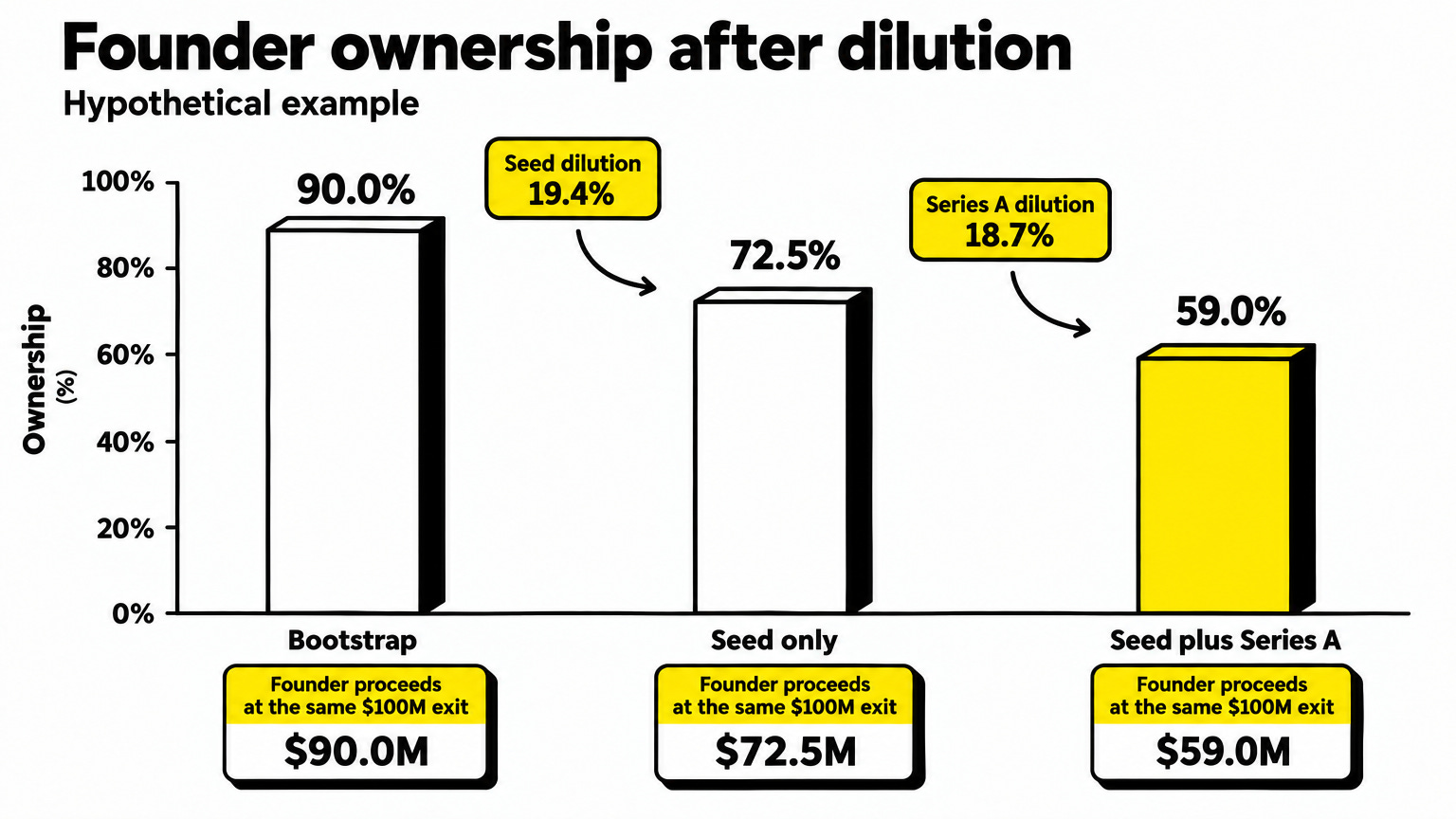
The math: 90% × (1 − 0.194) = 72.5%. Then 72.5% × (1 − 0.187) = 59.0%.
The gap between my 59.0% and Carta’s observed 36.1% likely comes from what this simple model leaves out: pre-seed rounds, SAFE conversions, option pool top-ups at each round, and additional rounds. I have not seen a source that decomposes the gap, so treat that as my reading.
Break-even. To match the bootstrapped founders’ $90 million, the seed plus Series A path needs an exit of $90M ÷ 0.590 ≈ $152.6 million in the simple model. With Carta’s observed 36.1%, it needs about $249 million.
If outside capital takes a company from a $100 million outcome to a $300 million one, the funded founders end up ahead ($176.9 million against $90 million). If it does not, they end up behind.
When preferences bite. At low exits, preferences change the picture. Suppose a company raises $19.2 million across seed and Series A (the two Carta median round sizes, $4.5 million and $14.7 million) and sells for $25 million. In the simple model, seed and Series A investors hold about 34.5% combined.
Converting would pay them about $8.6 million, so they take their $19.2 million preference instead. That leaves $5.8 million for common holders. The founders’ share of common (59.0% of the 65.5% that is common) comes to about $5.2 million.
Bootstrapped founders at 90% would receive $22.5 million from the same $25 million sale. Bootstrapped founders have no preference stack at all.
Mailchimp is the extreme case: two founders at 50% each, a roughly $12 billion sale, no investors to pay.
When to stop bootstrapping and raise
Raise when outside money buys something revenue cannot buy fast enough: a sales team for a market that is opening now, a response to a funded competitor, an acquisition, or a buffer when runway falls below what it takes to reach the next milestone.
Building a new product line: GitHub raised in 2012 to develop GitHub Enterprise, build marketing and sales capability, and compete with Atlassian, per Reuters and TechCrunch.
Funded competitors or consolidation: Braintree’s founder framed the 2011 round around an industry that would “consolidate dramatically,” and the money funded the Venmo purchase.
Slowing growth: Accel noted Atlassian’s growth had fallen to 5% shortly before its 2010 investment.
Liquidity for the team: Atlassian, Zapier and Linear used secondary sales so founders, early investors or employees could sell shares without the company issuing new ones.
A sensible rule is to start fundraising while several months remain, because fundraising itself takes time. I have no source for a specific number, so pick one that fits your sales cycle.
Market windows matter too. Carta’s Q1 2026 report opens with “Dilution is down. Terms favor founders.” and notes that more than 60% of venture capital raised by companies on Carta in Q1 went to AI companies. Carta’s Q3 2026 report says total deal count was down 21% year over year. Good terms and scarce deals can arrive at the same time.
Raising later may or may not get better terms. As covered earlier, no dataset settles it. Paul Graham’s advice on how to convince investors points in the same direction anyway: “the best way to convince investors is to make a startup that’s actually doing well, meaning growing fast, and then simply tell investors so.”
He also argues that startups “often raise money even when they are or could be profitable,” comparing it to insurance: “it’s no more foolish than buying insurance.” Linear’s untouched Series A and B funds look like that insurance policy.
Middle paths: angels, revenue-based financing and crowdfunding
Between pure bootstrapping and a priced venture round sit options that trade smaller amounts of equity, or none, for less capital.
Option: Seed-strapping / bootstrapper-friendly funds
Typical terms: $100,000 to $500,000 per Walling; TinySeed invests $120,000 for the first founder plus up to $20,000 per additional founder for 8%–15% (per Baremetrics, third-party)
Dilution: Small, permanent stake
Best fit: SaaS founders who want a year of focus and plan to grow on revenue
Option: Small seed (Zapier, Linear style)
Typical terms: Zapier ~$1.3M; Linear $4.2M
Dilution: Moderate; Carta median seed dilution 19.4% for priced rounds
Best fit: Teams that need to hire before revenue but expect early profitability
Option: Angels
Typical terms: ACA reports angel groups invested a median $88K per deal at valuations under $2.5M
Dilution: Small per angel; adds up across a round
Best fit: Founders who want advice and a few checks without a lead fund
Option: Revenue-based financing
Typical terms: Lighter Capital: repayment cap 1.3–1.5x, fixed share of revenue, minimum $200K ARR or $15K MRR
Dilution: None
Best fit: Software companies with recurring revenue and gross margins that can absorb repayments
Option: Regulation Crowdfunding
Typical terms: Up to $5M per 12 months; platform fees around 7%–8% of the raise
Dilution: Many small shareholders
Best fit: Consumer products with a community of customers
Option: SBA 7(a) loans
Typical terms: Up to $5M; capped rates; 75%–85% SBA guarantee
Dilution: None
Best fit: Businesses with assets or cash flow to support debt service
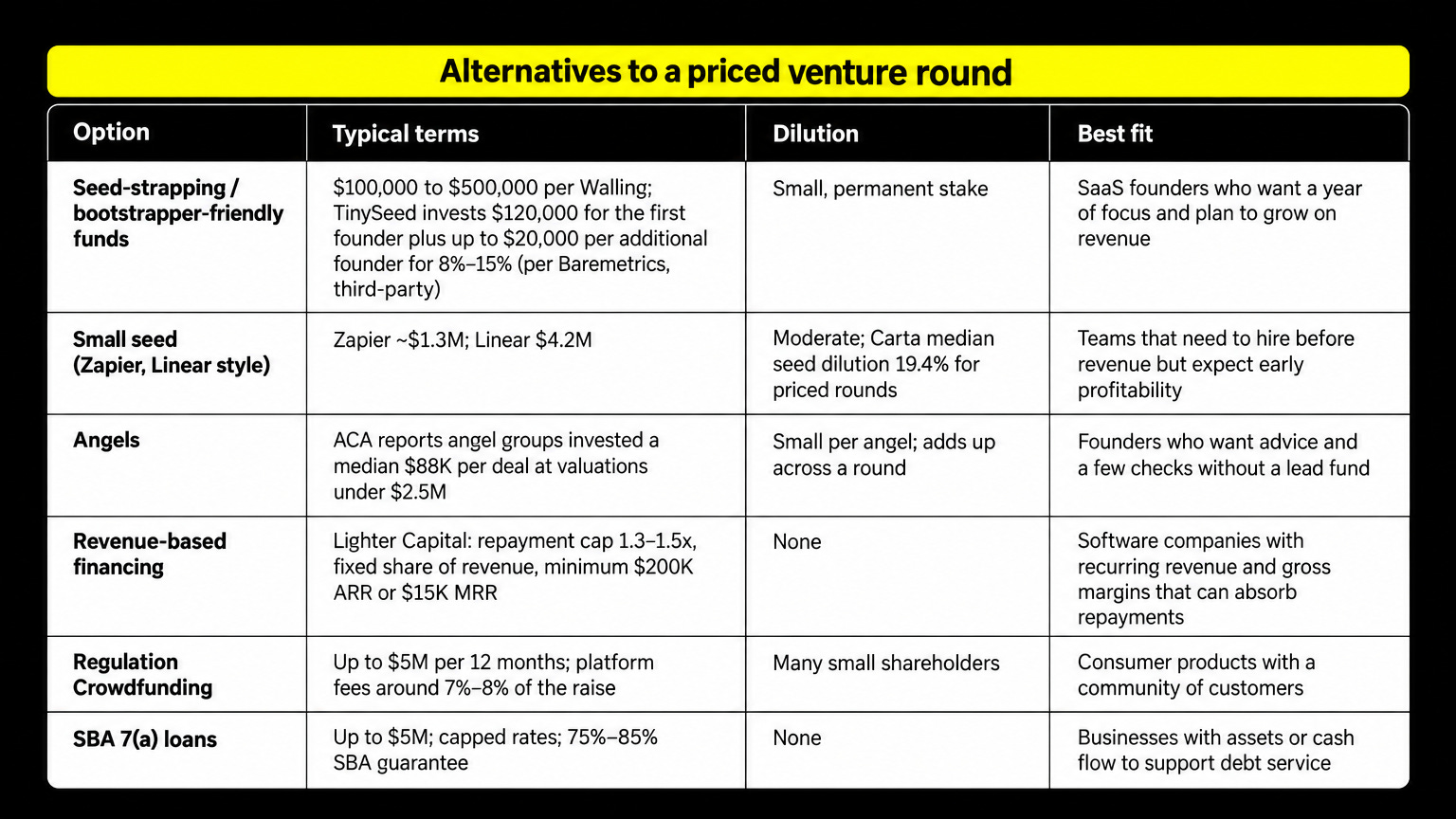
Sources for the table: TinySeed’s terms come from Baremetrics, a third-party description. The ACA figure comes from its review of the 2025 Angel Funders Report. Lighter Capital’s terms come from its FAQ and how-it-works page.
I found no named primary dataset for the median individual angel check in 2025 or 2026. Third-party pages cite $25,000 to $30,000 with unclear scope.
Seed-strapping has no settled definition. A YouTube explainer describes it as “a hybrid strategy for funding that combines elements of bootstrapping and Seed funding,” and its speaker says “what might be seed strapping for you might not be seed strapping for me or vice versa”.
TinySeed’s thesis page describes the companies it backs without using the term: “These are companies that may have bootstrapped or taken a small amount of seed capital early on, and then grown on customer revenues from there.” TinySeed’s About page says Walling and Einar Vollset started it because capital-efficient startups “had only two choices: bootstrap or raise venture capital”.
Zapier and Linear both fit a loose reading of seed-strapping, though Linear’s $4.2 million is well above Walling’s range.
Does AI make bootstrapping more viable?
I think AI makes the bootstrapped path more viable for the first million or so of revenue, and less decisive after that. Small teams now ship more before they hire. But distribution, inference costs, competition and the funding concentration in AI all work against the idea that a tiny team wins by default.
Evidence for the hypothesis
Teams are getting smaller. Carta reports the median seed team is now four employees, and average headcount at Series B dropped from 53 to 45 between 2023 and 2025. About 36% of startups founded on Carta in 2025 had solo founders, up from 31% in 2024.
Revenue per employee at some AI-native companies is far above SaaS norms. TechCrunch reported Lovable crossed $400 million ARR with 146 full-time employees, about $2.77 million per employee; both figures are company-reported. Aleph and Benchmarkit put the 2025 median B2B SaaS ARR per employee at $193K across 342 companies.
Smaller examples are self-reported. Adam Robinson says Retention.com reached $13 million ARR with the same six people it launched with. Zapier says it now has more AI agents than employees, per a Madrona interview.
For comparison, my own pre-AI data point is Know Your Company: seven-figure ARR with eight people over seven years. That ratio was possible without AI. What AI changes is how much a team of that size can build before it needs the next hire.
Evidence against it
Distribution: A Scigrowth post says: “AI makes software easier to build, but not easier to sell”. Braintree got 99% of its business from word-of-mouth, per TechCrunch, and Linear grew through product-led adoption. Cheaper building produces neither.
Competition: Lower build costs let more teams enter. A secondary summary reports that 25% of YC’s W25 batch had codebases over 95% AI-generated, a figure I could not verify against YC.
Model costs: ICONIQ’s 2026 data, as cited by SaaS Magazine, puts the average AI product gross margin at 52%, against the 80% benchmark of mature SaaS. The Information reports OpenAI’s gross margin fell to 33% in 2025. Lower margins shrink the profit that funds bootstrapped growth.
Funding concentration: PitchBook reports $407 billion of AI venture deal value in H1 2026, with OpenAI and Anthropic taking about $217 billion of it. Even the small-team poster child raised heavily. TechCrunch cites a $6.6 billion valuation for Lovable and the Wall Street Journal reports $13.3 billion. The two have not been reconciled.
Coordination and capital access: Solo founders raised only 20% of rounds closed on Carta in 2025, against 36% for two-founder startups. A small team that later wants the option to accelerate may find that option harder to get.
What AI changes for bootstrapped startups
AI can lower the cost of building a product before the first sale. Whether customer revenue can then fund growth depends on distribution, gross margins and how quickly competitors can expand. The AI companies cited above illustrate how much small teams can produce, and some raised substantial outside capital to grow.
Whether AI companies can fund growth from profits, as Mailchimp and Atlassian did, remains an open question. ICONIQ projects that AI product gross margins will rise to 53% in 2026 and 59% in 2027, as reported by The SaaS CFO.
Higher gross margins would leave more revenue to reinvest in growth. If inference costs stay high relative to revenue, companies may need outside capital to cover the gap as they scale.