

A team’s sales fell after it went remote. Its inside-sales manager pushed for a new CRM, and the purchase took more than two years. Jobs to Be Done gives us a way to ask what progress made that change worth pursuing.
What is Jobs to Be Done?
Jobs to Be Done (JTBD) is a theory of why people choose products and services to make progress in a particular circumstance. A job is the progress someone is trying to make. A switch interview traces what prompted them to look for a new solution, what drew them toward it, and what made them hesitate or stay with what they had.
Clayton Christensen and Bob Moesta helped develop Jobs to Be Done theory to explain the choices people make when they seek progress. In Competing Against Luck, Christensen and his co-authors define a job as “the progress that a person is trying to make in a particular circumstance.”
Chris, the inside-sales manager, was working with a homegrown system. The Re-Wired Group’s summary identifies the new CEO as a catalyst, the IT director as the stakeholder tied to 25 years of integrations, and the CFO as concerned about cost. That makes Chris’s case useful for studying an enterprise switch: the person pushing for change and the people weighing its costs had different stakes in the decision.
Christensen’s milkshake example illustrates how commuters chose something that would keep them occupied on a long drive to work.
How JTBD developed
Theodore Levitt’s Marketing Myopia argued that companies should define their business around customer needs. Tony Ulwick developed Outcome-Driven Innovation, a method that measures how important outcomes are to customers and how satisfied they are with existing solutions.
Christensen and Moesta helped develop Jobs Theory around progress in a particular circumstance. Moesta and Chris Spiek developed the switch interview and the four forces model to investigate why people change solutions.
What is the jobs to be done framework?
To reconstruct a purchase, look at the customer’s circumstance, the progress they sought, and the alternatives they considered. A job can have functional, social, and emotional dimensions. The switch interview helps you trace how those dimensions shaped a real decision.
Apply the framework to the CRM purchase. The circumstance was declining sales after a shift to remote work. The progress sought was to improve sales under those conditions. The incumbent was the homegrown system, with long-standing integrations that made sticking with it a meaningful option. The public sources establish the functional goal and the organizational tradeoffs. They give less detail about Chris’s personal emotional or social stakes.
How is JTBD different from personas or demographic segmentation?
Demographic segmentation groups people or organizations by observable attributes such as company size or region. A persona synthesizes patterns in an audience, such as a sales manager’s goals, constraints, and behaviors. JTBD looks at the progress someone seeks in a particular circumstance and what moves them toward a switch. A well-researched persona can incorporate behaviors and motivations.
In the CRM case, an inside-sales manager persona helps a product team understand Chris’s role. The job becomes clearer when we add the circumstances: sales fell after the shift to remote work, and Chris saw a CRM change as part of the turnaround. Another inside-sales manager might consider the same product to consolidate reporting after a merger. The role is the same, but the reason to act and the alternatives under consideration can differ. That second situation is a hypothetical comparison.
The switching timeline and the four forces
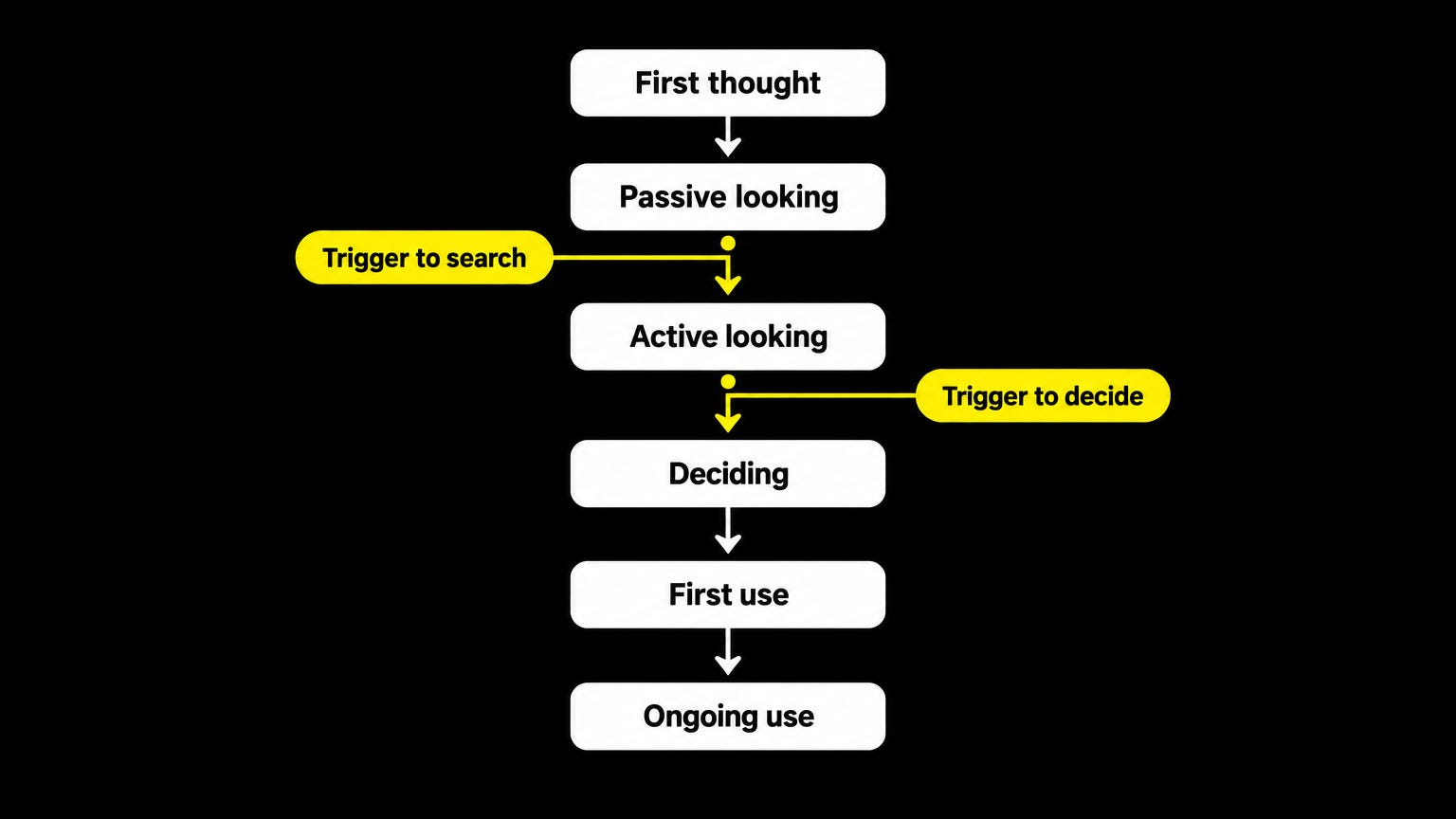
Use the switching timeline to reconstruct the path from first thought through passive looking, active looking, deciding, first use, and ongoing use. A trigger can move someone into active search, and a later event can prompt the decision. Treat the stages as prompts for the interview and record gaps where you still need evidence.
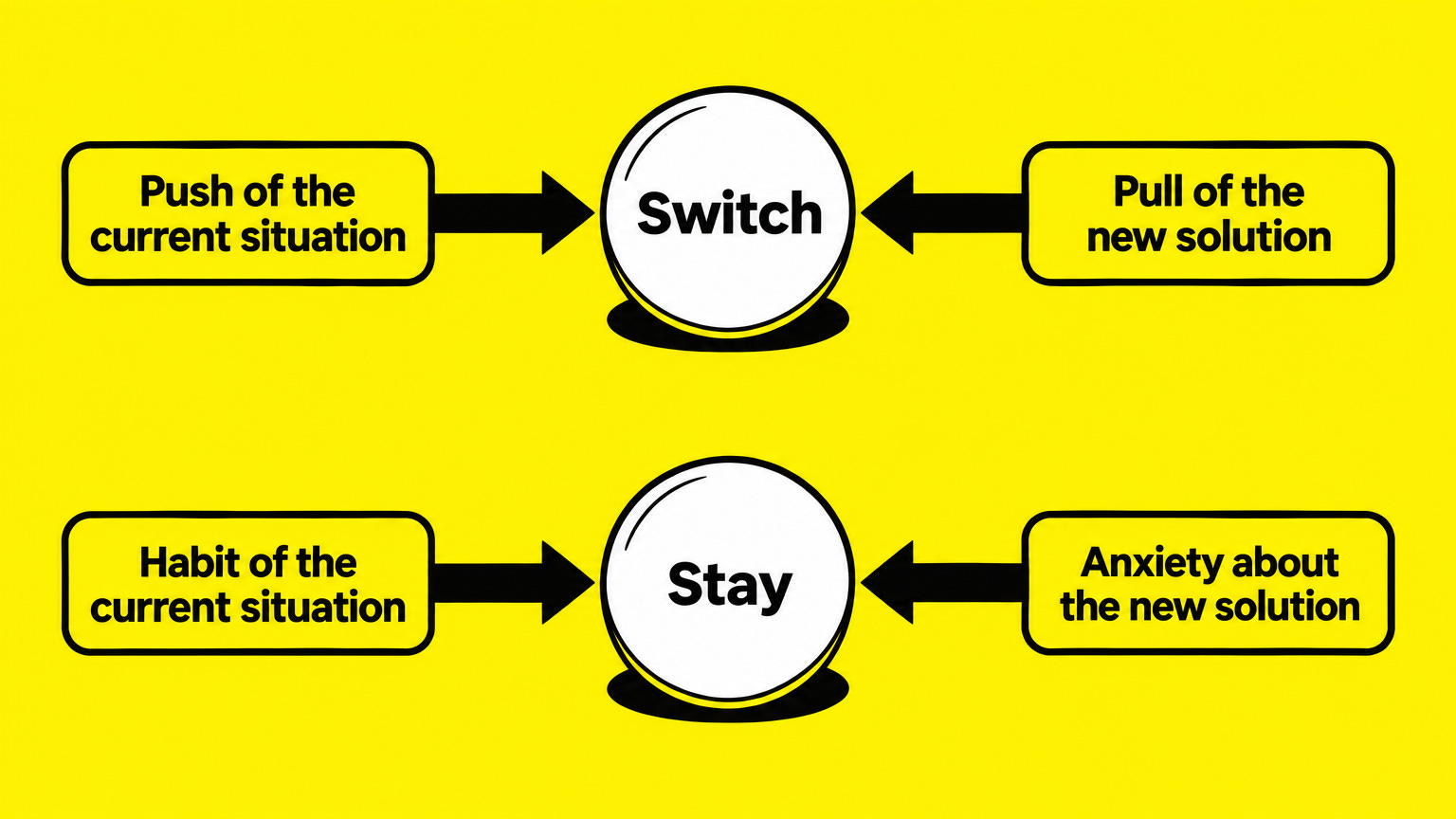
Moesta and Spiek use four forces to explain what moves a customer toward a switch and what holds them back.
Push of the current situation. A problem or frustration makes the current way harder to live with.
Pull of the new solution. The customer can picture the progress the new option would help them make.
Anxiety about the new solution. The customer worries about the cost, risk, or uncertainty of changing.
Habit of the current situation. Familiar routines and existing investments make staying easier.
The same page states the switching condition as Push + Pull > Anxiety + Habit. People switch when the push and pull outweigh their anxiety about the new solution and their habit of staying with the present one.
The account of the purchase and the map of the people involved give us a starting point for tracing the switch.
First thought and passive looking. The public sources don’t establish when Chris first considered replacing the CRM or how he explored options informally.
Push and catalyst. Sales fell after the shift to remote work. The course also identifies a new CEO questioning the homegrown system as a catalyst. The public account leaves their exact sequence open.
Pull. Chris saw a new CRM as part of the sales turnaround. What drew him to the chosen CRM remains open.
Anxiety. The CFO was concerned about cost, and Chris had to secure budget while sales were down.
Habit. The IT director had 25 years of integrations tied to the incumbent system, according to the course map.
Decision and use. The public introduction describes a purchase and rollout following a process that lasted more than two years. It gives no detail on first use or sustained adoption.
How to run a switch interview and write a job statement
A switch interview reconstructs a real decision in the customer’s own words. Ask for specific events, then map what you heard onto the timeline and forces.
Who to recruit and how many
Recruit recent switchers. The guide suggests starting with people who switched in the past 30 to 90 days. In the mattress Q&A, Spiek adjusts the window to the kind of purchase.
Recruit for contrast. Include people who switched to you, switched away, or nearly switched. Comparing their stories helps surface different forces.
Review in batches. The guide says patterns often emerge within five to eight interviews for a job. Moesta describes interviewing in batches of ten and stepping back between batches.
Give the story time. The guide suggests allowing 45 to 90 minutes.
Treat the counts as starting points. In adjacent qualitative research, a study of 25 in-depth interviews reached code saturation at nine interviews but needed 16 to 24 for meaning saturation. Ten interviews may tell you what forces exist without telling you how they weigh against each other.
What to ask at each stage
Start with a concrete prompt like “When did you first start thinking about this?” Then ask what happened next and listen for the forces as the person describes events.
For the CRM case, a follow-up interviewer could ask when Chris first considered changing systems, what he did next, what other options he considered, who had to sign off, and what happened during the first rollout. Ask for a specific event each time. These are suggested prompts for filling gaps in the public account.
Tag the evidence to the forces
Mark the events and statements that show push, pull, anxiety, or habit. Start with the push and keep track of whose perspective each piece of evidence reflects.
In the CRM case, the sales decline is evidence of push. Budget concerns suggest anxiety, and the integrations illustrate habit. Chris envisioned a sales turnaround with a new CRM, which suggests what made changing systems attractive. The public material leaves open what drew him to the chosen product.
Turn the evidence into a job statement
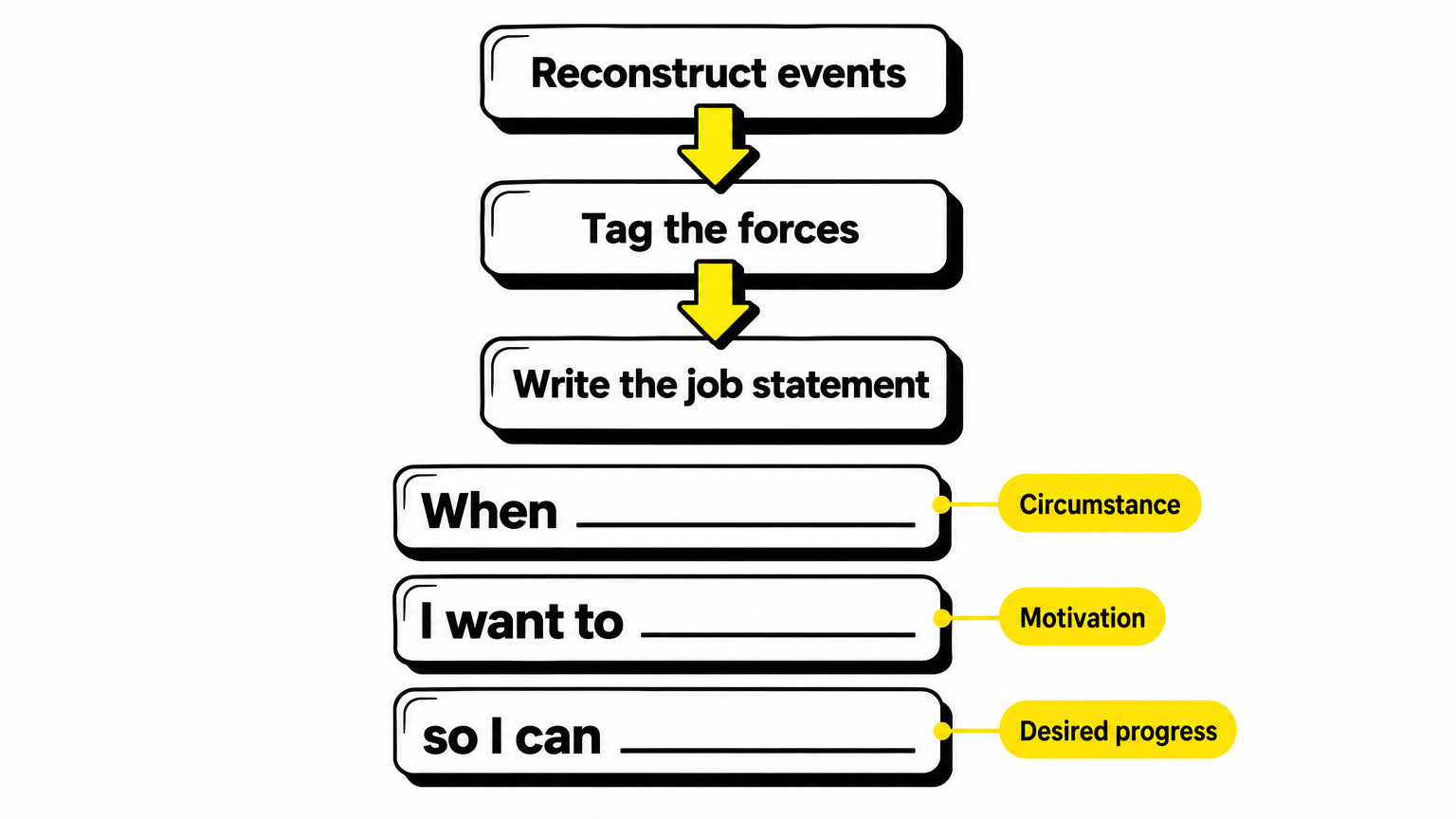
This worksheet borrows Intercom’s Job Story format. Paul Adams published the three-part template in 2013, and Intercom later credited Alan Klement with naming it. Use the template to capture the circumstance, motivation, and desired progress.
Map each interview first, then compare timelines and forces across interviews to see which jobs recur. Treat a statement from one account as provisional.
Here’s one way to state the job provisionally, based on the public CRM summaries.
When my inside-sales team’s performance drops after moving to remote work, I want to help the team sell effectively in the new setup so I can turn sales around.
A follow-up interview should probe what selling effectively meant to Chris, what he expected the CRM to change, and which alternatives competed for the same job.
A JTBD worksheet for PMs and founders
Use one worksheet per switch. Record the evidence and whose perspective it represents before writing the job statement.
Interviewee and role:
Circumstance and desired progress:
Old solution and alternatives:
First thought and passive looking:
Trigger and active looking:
Decision and stakeholders:
First use and ongoing use:
Push:
Pull:
Anxiety:
Habit:
Job statement: When ___, I want to ___, so I can ___.
Next question or experiment:
Worked worksheet: Chris’s CRM purchase
This worksheet draws on the public account of the CRM interview and the stakeholder map. The job statement is our synthesis, and open fields are questions to take back to the interview.
Interviewee and role. Chris, inside-sales manager and purchase champion
Circumstance and desired progress. Sales fell after the team went remote. Chris wanted to turn sales around.
Old solution and alternatives. Homegrown system. Other products and workarounds are undocumented in the summaries.
First thought and passive looking. Open. Ask when a CRM change first came up and what Chris did before formally looking.
Trigger and active looking. The course identifies the new CEO as a catalyst. The exact sequence and shortlist are open.
Decision and stakeholders. Chris navigated competing projects and budget approval while sales were down. The public account describes a purchase process lasting more than two years.
First use and ongoing use. Rollout was part of the effort. Adoption and sales outcomes remain open.
Push. Sales declined after the move to remote work.
Pull. Chris saw a new CRM as part of the sales turnaround. What drew him to the chosen CRM remains open.
Anxiety. The CFO raised cost concerns.
Habit. The existing system had 25 years of integrations, a concern the course map associates with the IT director.
Job statement. Help an inside-sales team sell effectively after moving to remote work so it can turn sales around.
Next question. What convinced finance and IT to move forward, and what did Chris look for during rollout to tell whether the change was helping?
A PM could use the worksheet to test whether migration support or integration compatibility would reduce friction for buyers with long-standing systems. A founder could interview other sales champions to learn what makes a CRM change urgent enough to win funding. These are hypotheses prompted by the case.
Self-check
Find the push. Why was Chris motivated to act? Sales had fallen after the move to remote work.
Distinguish anxiety from habit. The CFO’s concern about cost is anxiety. The integrations tied to the existing system illustrate habit.
Write a job statement. Describe the circumstances and the progress Chris sought. Then identify one open interview question that could change your interpretation.